
Star clusters
Hubble/Chandra/Spitzer composite image of NGC 602, in the “wing” of the Small Magellanic Cloud
April 4, 2013 · ESA/Hubble · Hydrus
Zoom to full resolution See where it is in the 3D sky Original on ESA/Hubble ↗
NASA’s Chandra X-ray telescope has made the first detection of X-ray emission from young solar-type stars that lie outside our Milky Way galaxy. They live in a region known as the “Wing” of the Small Magellanic Cloud, a satellite galaxy of our Milky Way.
X-rays from young stars trace how active their magnetic fields are. Magnetic activity provides clues to a star’s rotation rate and the rising and falling of hot gas in the star’s interior. Astronomers suggest that if the X-ray properties of young stars are similar in different environments around our galaxy, then other related properties, such as the formation of planets, are also likely to be similar.
In this composite image of the Wing from NASA’s Great Observatories, the Chandra data are shown in purple; visible light seen by the NASA/ESA Hubble Space Telescope is in red, green, and blue; and infrared data from the Spitzer Space Telescope are coloured red.
More from Hydrus and nearby
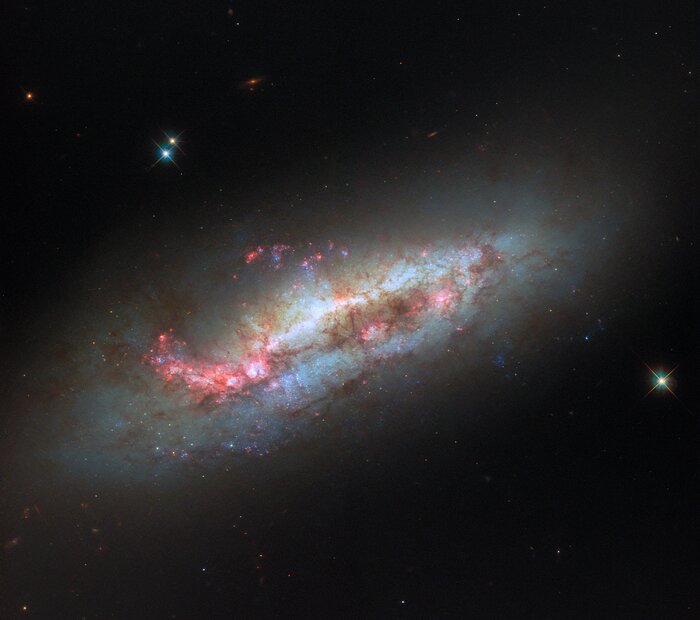 A disruptive neighbourNovember 10, 2025
Globular Star Cluster NGC 1466September 9, 2019
 Globular Cluster NGC 1466December 24, 2018
 Hubble image of PGC 6240October 10, 2013
 Wide field image of PGC 6240 (ground-based image)October 10, 2013
 New stars shed light on the pastJanuary 8, 2007
 Overview of the region around N90 (ground-based image)January 8, 2007
Zoom into 47 Tucanae (No Narration)July 18, 2013 · video