
Solar System
White Dwarf Yields Key to Planet's Mass
July 10, 2003 · ESA/Hubble · B 1620+26, Messier 4 , NGC 6121
Three unlikely companions - two burned-out stars and a planet - orbit each other near the crowded core of an ancient globular cluster of more than 100,000 stars. Only one companion, however, is visible in the images. In the image at right, taken by NASA / ESA Hubble Space Telescope, the white arrow points to a burned-out white dwarf star. Radio astronomers discovered the white dwarf and the other burned-out star - a rapidly spinning neutron star, called a pulsar - a decade ago. The third companion's identity was a mystery. Was it a planet or a brown dwarf? The object was too small and too dim to image.
Hubble observations of the dim white dwarf helped astronomers to precisely measure the mass of the mystery object (2.5 times larger than the mass of Jupiter), confirming that it is a planet. In fact, it is the farthest and oldest known planet. Hubble's Wide Field and Planetary Camera 2 resolved individual stars near M4's densely packed core [right] and pinpointed the white dwarf.
More Hubble images of B 1620+26, Messier 4 , NGC 6121
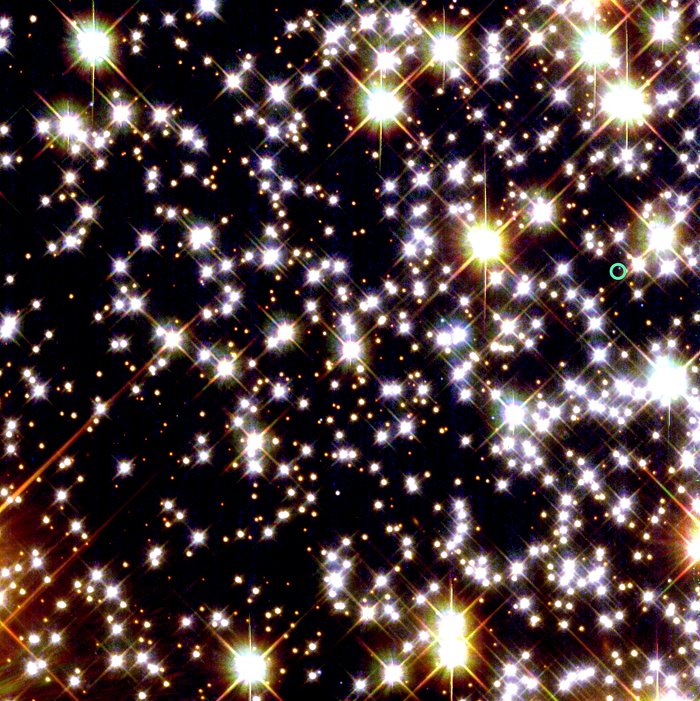 HST/WFPC2 Image with Location of PulsarJuly 10, 2003
Hubble’s Close Encounter with Mars — August 26, 2003August 27, 2003
Sharpest Ever Color View of MarsAugust 27, 2003
Rotating Mars GlobeAugust 27, 2003 · video
MARS: Closest EncounterAugust 27, 2003 · video
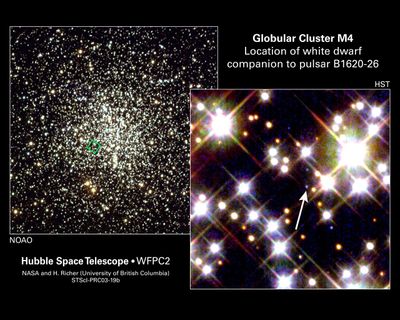 White Dwarf Star Yields Key to Planet’s MassJuly 10, 2003
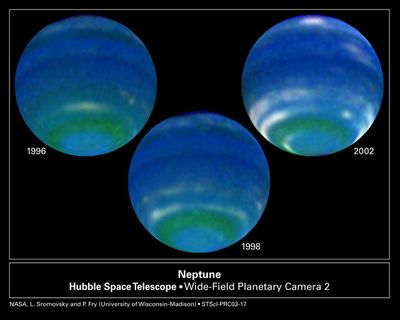 Springtime on Neptune: Increased Brightness Shows Seasonal ChangeMay 15, 2003
Springtime on Neptune – 1996 Image of NeptuneMay 15, 2003