Exoplanets
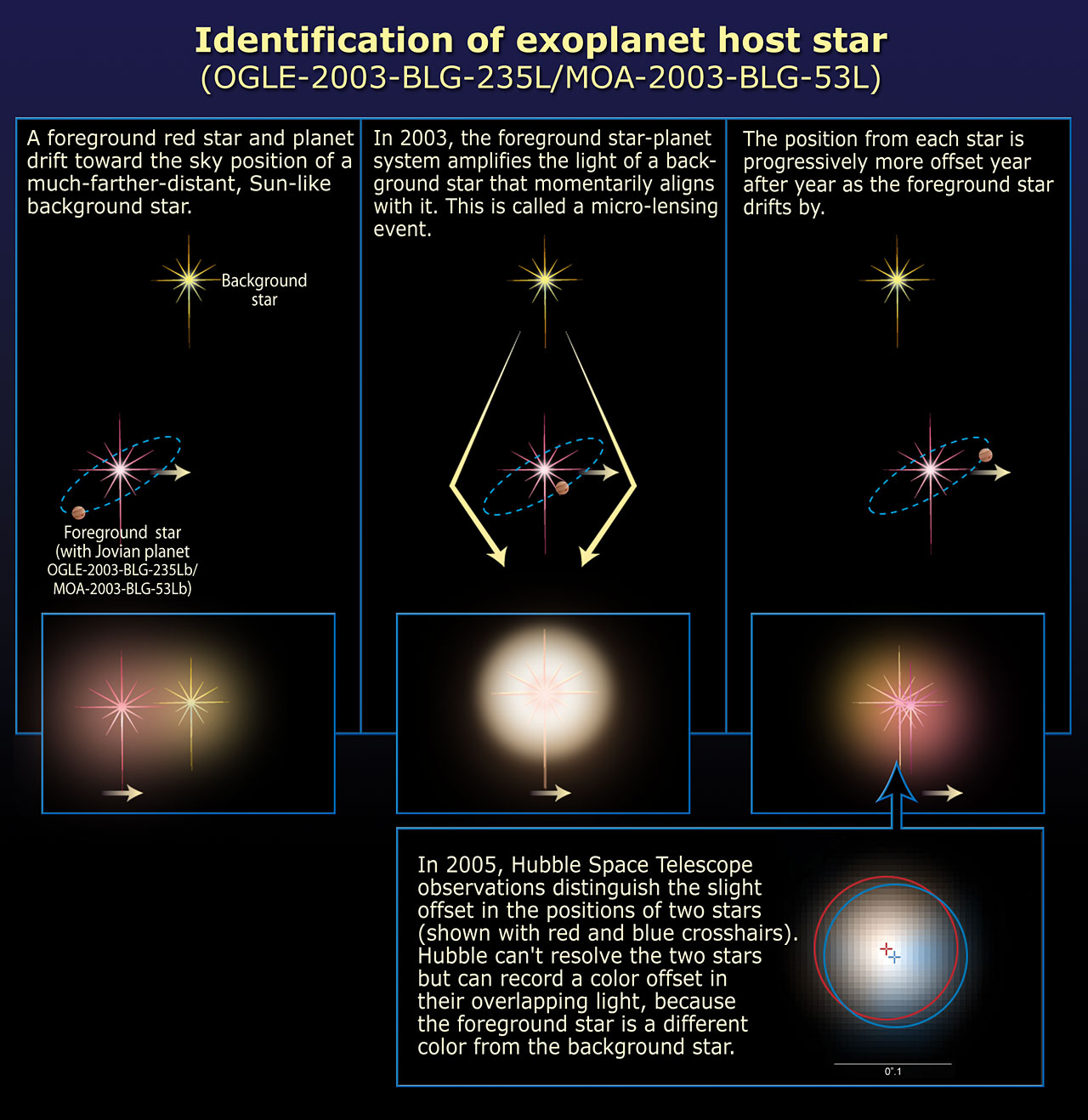
Identification of extrasolar planet host star
August 8, 2006 · ESA/Hubble · MOA 2003-BLG-53 , OGLE-2003-BLG-235L
[bottom left text] Hubble Space telescope observed and identified the host star to a gravitationally lensed planet first discovered in 2003 by ground-based telescopes.
[left box] A foreground red star and planet drifts toward the sky position of a much farther sunlike background star.
[middle-boxes] In 2003, the foreground star-planet system slightly amplifies the light of a background star that momentarily aligns with it. This is called a microlensing event.
[right box] The light from each star is progressively more offset year after year as the foreground star drifts by.
[bottom right box] In 2005, Hubble Space Telescope observations distinguished the light from the two stars. This was possible because the foreground star turns out to be a different colour from the background star. By observing the stars though a red and blue filter, astronomers were able to enhance the visibility of the offset. The relative offset is 0.7 milliarcseconds (the angular width of a dime seen 3,000 miles away) from the source star. (This is below Hubble's resolution, but still a measurable effect.) The deduced positions of the two stars in 2005 are shown with red and blue crosshatches.
More Hubble images of MOA 2003-BLG-53 , OGLE-2003-BLG-235L
 Identification of extrasolar planet host starAugust 8, 2006
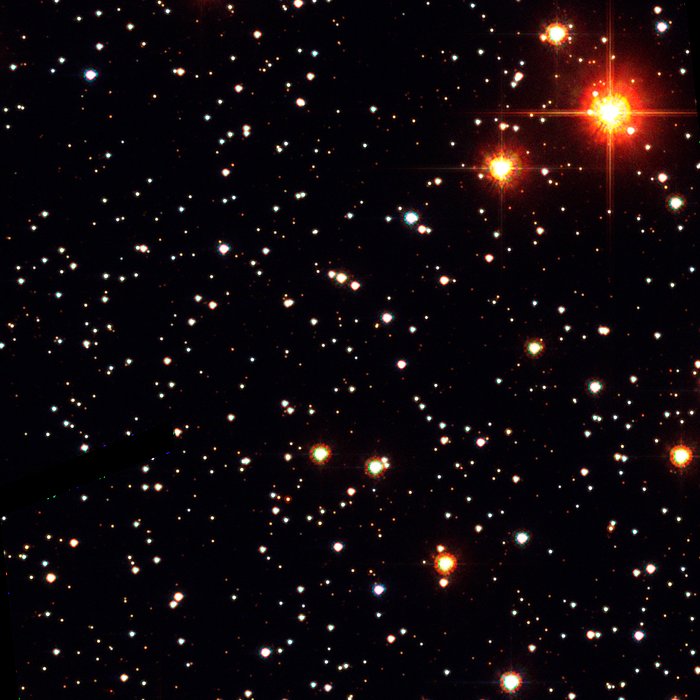 Planetary Host StarAugust 8, 2006
Zoom into SWEEPS ImageOctober 4, 2006 · video
Transiting Planet Loop AnimationOctober 4, 2006 · video
 Identification of Exoplanet Host StarAugust 8, 2006
Target Region for Panetary Host Star OGLE-2003-BLG-235L/MOA-2003-BLG-53LAugust 8, 2006
Planetary Host Star Enlarged DetailAugust 8, 2006
Identification of Exoplanet Host StarAugust 8, 2006