
Illustrations
Hubble probes the invisible halo of a galaxy
November 22, 2011 · ESA/Hubble
Distant quasars serve as distant lighthouse beacons that shine through the gas-rich "fog" of hot plasma encircling galaxies. At ultraviolet wavelengths, Hubble's Cosmic Origins Spectrograph (COS) is sensitive to absorption from many ionised heavy elements, such as nitrogen, oxygen, and neon. COS's high sensitivity allows many galaxies that happen to lie in front of the much more distant quasars to be studied. The ionised heavy elements serve as proxies for estimating how much mass is in a galaxy's halo.
More illustrations
 The Venus Transit 2004 (artist's impression)January 12, 2012 · video
 The Venus Transit 2004 (artist's impression)January 12, 2012 · video
 Artist’s impression of S 106December 15, 2011 · video
 Hubble papers published over the yearsDecember 6, 2011
 A tale of two galaxiesNovember 22, 2011
 Using gravitational lensing to observe the disc around a black holeNovember 4, 2011
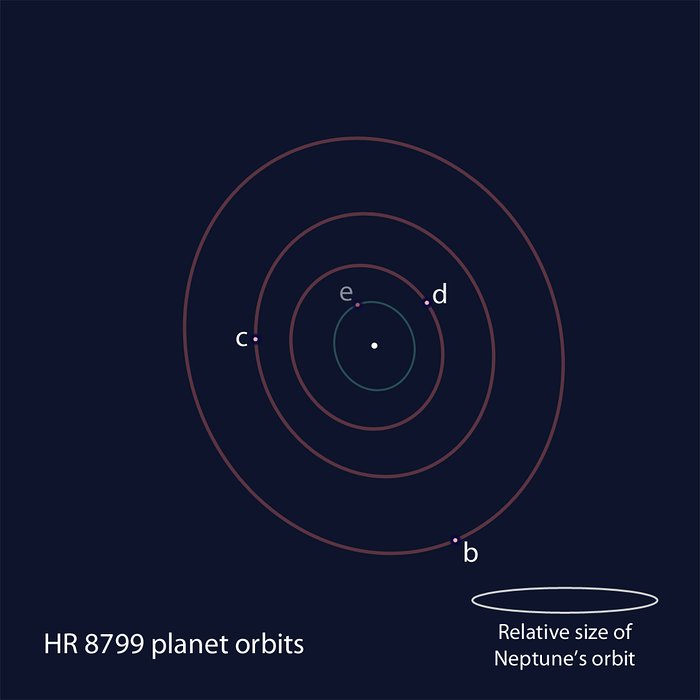 Positional schmatic of the members of the HR 8799 exoplanet systemOctober 10, 2011
 HR 8799 planetary systemOctober 10, 2011