
Star clusters
Spiral disk and globular star clusters at the core of a colliding galaxy
May 25, 1993 · ESA/Hubble · IRAS F22199-0422 , NGC 7257
[Left] Ground-based Telescopic Photograph NGC 7252 has been considered the prototypical example of a merger between two disk-shaped galaxies. The galaxy has a pair of long tails that are unambiguous evidence of the effects of gravitational tidal forces from a galaxy merger. The galaxy is nicknamed the "Atoms-for-Peace" galaxy because its stars form a bizarre loop-like structure that resembles a schematic diagram of electrons orbiting an atomic nucleus. (In December 1953, U.S. President Dwight 0. Eisenhower made his "Atoms for Peace" speech to foster peaceful applications of nuclear energy.) The galaxy is located 300 million light-years away in the constellation Aquarius.
[Right] Hubble Space Telescope Planetary Camera Image of Galaxy CoreA NASA/ ESA Hubble Space Telescope image of the core of the peculiar galaxy NGC 7252 reveals a striking "mini-spiral" disk of gas and stars, and about 40 exceptionally bright and young globular star clusters.
More star clusters
Hubble Images of Star Cluster Before and After Astronauts Fixed Hubble’s FlawJune 17, 1993
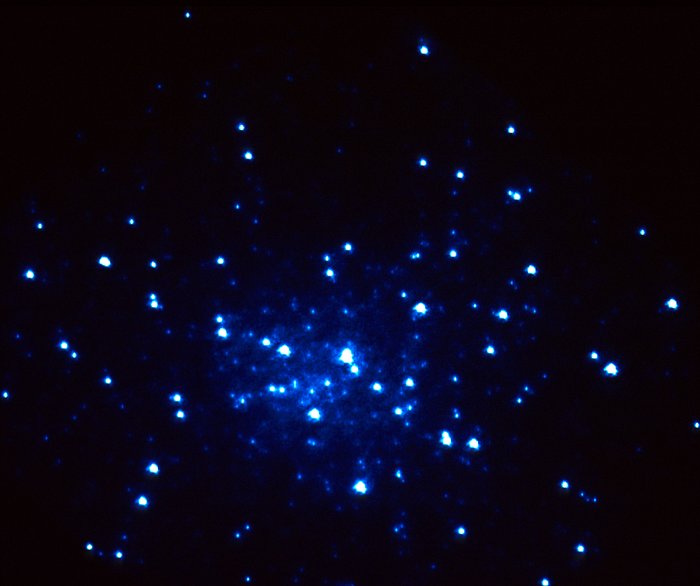 HST image of hot blue stars at the core of M15June 9, 1993
Hot Blue Stars at the Core of Globular Cluster M15June 9, 1993
A Stellar Close Encounter at the Core of Globular Cluster M15June 9, 1993
 NGC 7257: spiral disk and globular star clusters at the core of a colliding galaxyMay 25, 1993
Merging galaxy NGC 7252 From the Ground (left) and From Hubble (right)May 25, 1993
NGC 7252: Spiral Disk and Globular Star Clusters at the Core of a Colliding GalaxyMay 25, 1993
Clearest View Yet of Massive Star ClusterApril 1, 1992