
Galaxies · ESA/Hubble Picture of the Week
True blue
June 15, 2015 · ESA/Hubble · UGC 11411 · Draco
Zoom to full resolution See where it is in the 3D sky Original on ESA/Hubble ↗
This NASA/ESA Hubble Space Telescope image shows a galaxy known as UGC 11411. It is a galaxy type known as an irregular blue compact dwarf (BCD) galaxy.
BCD galaxies are about a tenth of the size of a typical spiral galaxy such as the Milky Way, and are made up of large clusters of hot, massive stars that ionise the surrounding gas with their intense radiation. Because these stars are so hot they glow brightly with a blue hue, giving galaxies like UGC 11411 their characteristic blue tint. With these massive stars being less than 10 million years old, they are very young compared to stellar standards. They were created during a starburst, a galaxy-wide episode of furious star formation. UGC 11411 in particular has an extremely high star formation rate, even for a BCD galaxy.
Unusually for galaxies with such intense star-forming regions, BCDs don’t contain either a lot of dust, or the heavy elements that are typically found as trace elements in recently formed stars, making their composition very similar to that of the material from which the first stars formed in the early Universe. Because of this astronomers consider BCD galaxies to be good objects to study to improve our understanding of primordial star-forming processes.
The bright stars in the image are foreground stars in our own Milky Way galaxy.
More from Draco and nearby
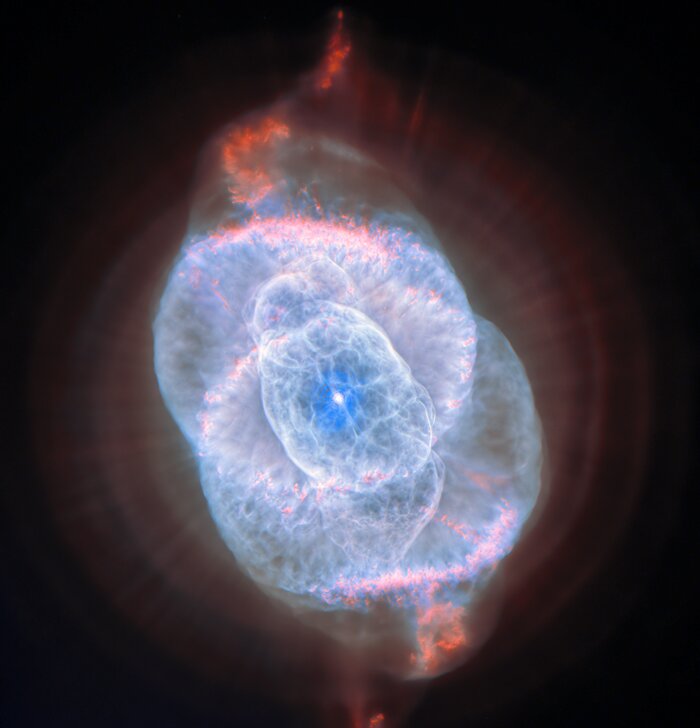 Looking at the Cat’s Eye Nebula with HubbleMarch 3, 2026
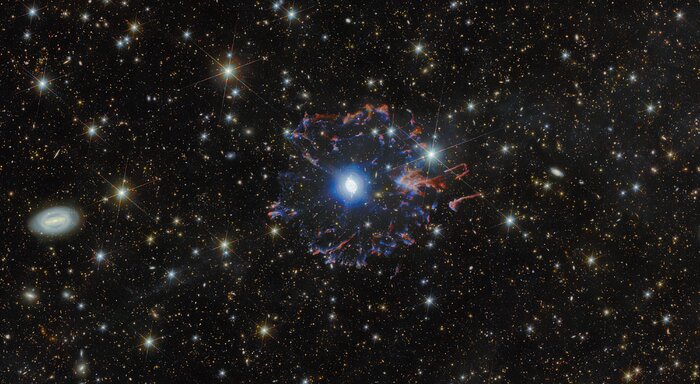 Euclid and Hubble's view of Cat's Eye NebulaMarch 3, 2026
Draco Dwarf SpheroidalJuly 11, 2024
 Cosmic leviathanMay 8, 2023
 Lonely SpiralDecember 27, 2021
 A Galaxy on EdgeJune 22, 2020
 A Close RelationshipNovember 25, 2019
Central Black Hole in NGC 3147July 11, 2019