
Galaxies · ESA/Hubble Picture of the Week
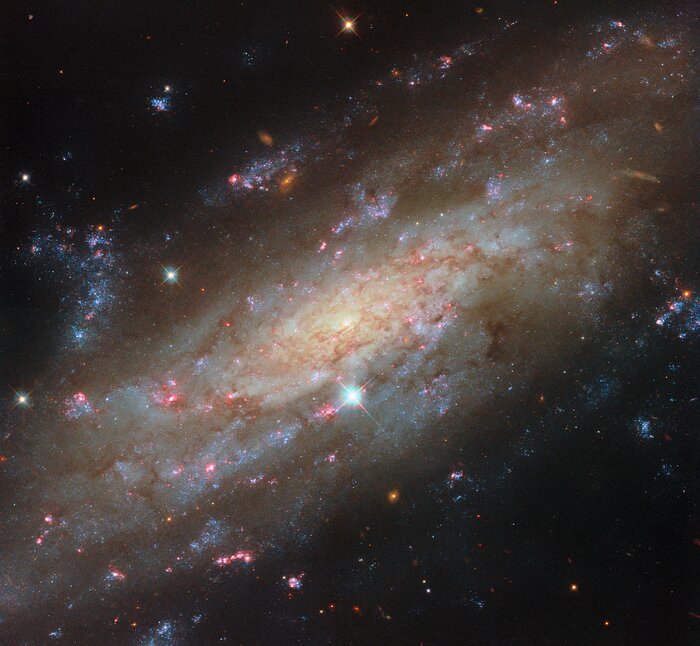
A galaxy fit to burst
July 18, 2016 · ESA/Hubble · NGC 3125 · Antlia
Zoom to full resolution See where it is in the 3D sky Original on ESA/Hubble ↗
This NASA/ESA Hubble Space Telescope image reveals the vibrant core of the galaxy NGC 3125. Discovered by John Herschel in 1835, NGC 3125 is a great example of a starburst galaxy — a galaxy in which unusually high numbers of new stars are forming, springing to life within intensely hot clouds of gas.
Located approximately 50 million light-years away in the constellation of Antlia (The Air Pump), NGC 3125 is similar to, but unfathomably brighter and more energetic than, one of the Magellanic Clouds . Spanning 15 000 light-years, the galaxy displays massive and violent bursts of star formation, as shown by the hot, young, and blue stars scattered throughout the galaxy’s rose-tinted core. Some of these clumps of stars are notable — one of the most extreme Wolf–Rayet star clusters in the local Universe, NGC 3125-A1, resides within NGC 3125.
Despite their appearance, the fuzzy white blobs dotted around the edge of this galaxy are not stars, but globular clusters . Found within a galaxy’s halo , globular clusters are ancient collections of hundreds of thousands of stars. They orbit around galactic centres like satellites — the Milky Way, for example, hosts over 150 of them.
More from Antlia and nearby
 Starry spiral in a familiar neighbourhoodApril 30, 2026
Galaxy AM 1054-325February 8, 2024
 Galactic DiversityDecember 9, 2019
 Mapping the nearby UniverseSeptember 25, 2017
 Flat as a pancakeDecember 23, 2013
 A spiral in the Air PumpSeptember 2, 2013
 Glitter galaxy — An edge-on view of the ESO 318-13 galaxyDecember 3, 2012
 Antlia dwarf galaxy peppers the sky with starsFebruary 27, 2012