
Galaxies · ESA/Hubble Picture of the Week
Hubble Hunts an Unusual Galaxy
November 21, 2022 · ESA/Hubble · AM 0417-391 · Eridanus
Zoom to full resolution See where it is in the 3D sky Original on ESA/Hubble ↗
The galaxy merger Arp-Madore 417-391 steals the spotlight in this image from the NASA/ESA Hubble Space Telescope. The Arp-Madore catalogue is a collection of particularly peculiar galaxies spread throughout the southern sky, and includes a collection of subtly interacting galaxies as well as more spectacular colliding galaxies . Arp-Madore 417-391, which lies around 670 million light-years away in the constellation Eridanus in the southern celestial hemisphere, is one such galactic collision. The two galaxies have been distorted by gravity and twisted into a colossal ring, leaving the cores of the two galaxies nestled side by side.
Hubble used its Advanced Camera for Surveys (ACS) to capture this scene — the instrument is optimised to hunt for galaxies and galaxy clusters in the ancient Universe. Hubble’s ACS has been contributing to scientific discovery for 20 years , and throughout its lifetime it has been involved in everything from mapping the distribution of dark matter to studying the evolution of galaxy clusters.
This image comes from a selection of Hubble observations designed to create a list of intriguing targets for follow-up observations with the NASA/ESA/CSA James Webb Space Telescope , as well as other ground-based telescopes. Astronomers chose a list of previously unobserved galaxies for Hubble to inspect between other scheduled observations. Over time, this lets astronomers build up a menagerie of interesting galaxies while using Hubble’s limited observing time as fully as possible.
Image description
Image description: Two galaxies right of centre form a ring shape. The ring is narrow and blue, and the cores of the two galaxies form a bulge on the ring’s side. A bright, orange star lies above the ring. Two smaller spiral galaxies appear left of centre, as well as a few stars. The background is black and speckled with very small stars and galaxies.
More from Eridanus and nearby
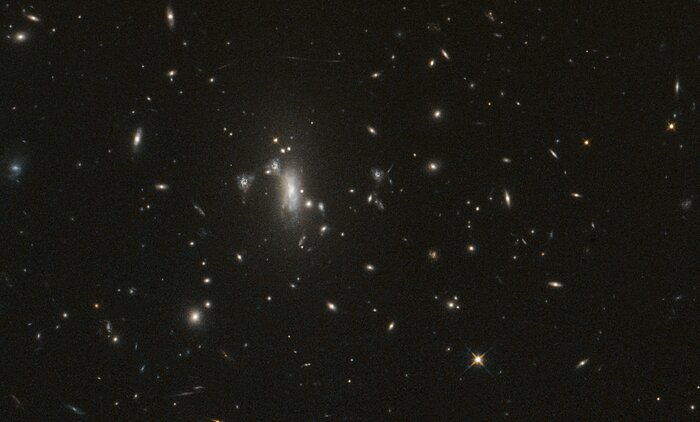 Hubble seeks lensed supernova, marks 200,000 orbitsSeptember 30, 2026
 SN 2025pht in NGC 1637February 23, 2026
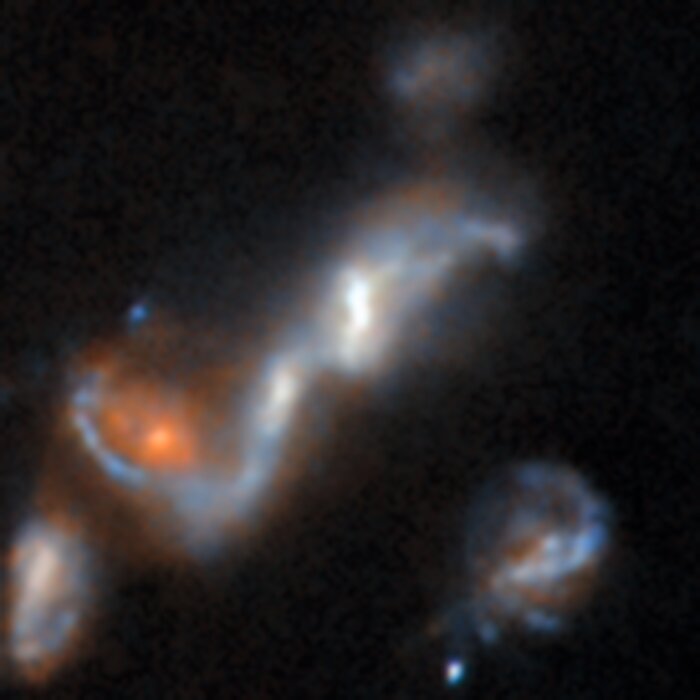 An anomaly from Hubble’s archive — Merging galaxies 2January 27, 2026
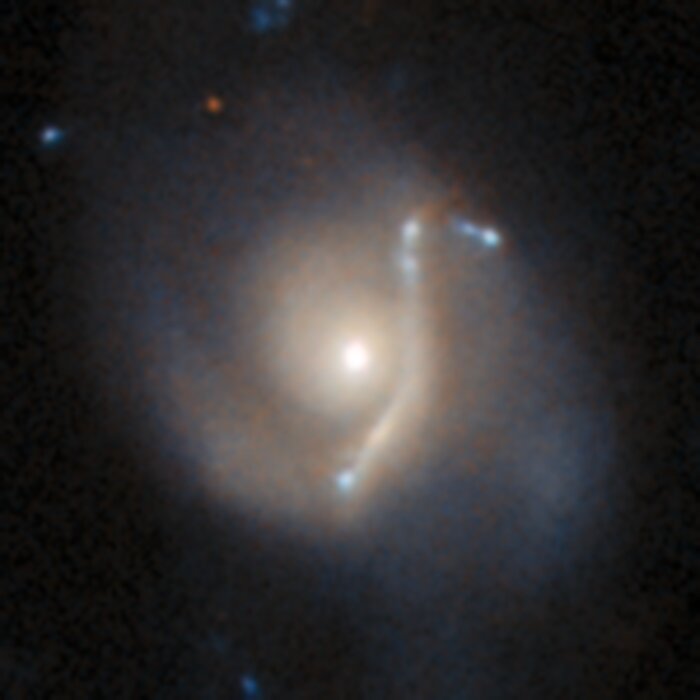 An anomaly from Hubble’s archive — Gravitational lens 1January 27, 2026
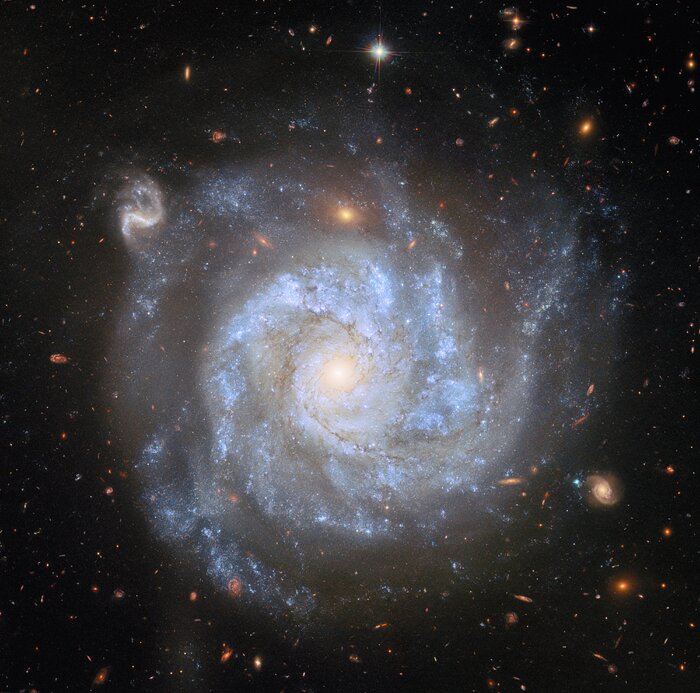 A supernova-rich spiralJuly 28, 2025
 Starry spectacleJune 2, 2025
 Signs of the stellar lifecycleDecember 2, 2024
 A supernova spotlightAugust 5, 2024