
Deep fields & lensing
Galaxy MXDFz4.4 (Hubble and Webb Image)
June 23, 2026 · NASA · Fornax
Zoom to full resolution See where it is in the 3D sky Original on NASA ↗
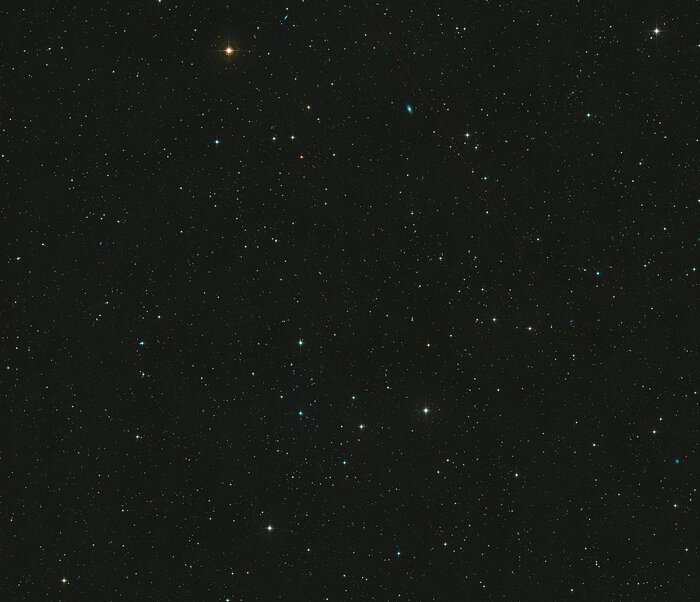
Oddball galaxy MXDFz4.4 existed only 1.4 billion years after the big bang, when the universe was still a “swirl” of opaque and clear gas as the Era of Reionization was ending. Detailed visible-light images from NASA’s Hubble Space Telescope revealed that several bursts of younger stars cleared the space in and around the galaxy. The team sifted through extensive Hubble observations that produced deep exposures of the field where this galaxy is located.
The color assignments in the image, which combines data from the Hubble and James Webb space telescopes, emphasize the specific wavelengths of light Hubble observed where ionizing photons from MXDFz4.4 were detected, which transformed the gas around them from opaque to clear.
Researchers have long sought evidence to explain how the universe transitioned from foggy to transparent — and Hubble has provided the first example this close to the Era of Reionization of how that might have happened within an individual galaxy. “Hubble returned the only view that shows the galaxy’s ionizing photons — light capable of clearing the ‘fog’ in and around the galaxy,” said lead author Ilias Goovaerts, a postdoctoral fellow at the Space Telescope Science Institute in Baltimore.
About the colours
These images were acquired by the ACS/WFC instrument on Hubble and the NIRCam instrument on Webb. Several filters were used to sample varying wavelength ranges. The color results from assigning different hues (colors) to each monochromatic (grayscale) image associated with an individual filter. In this case, the assigned colors are: Blue (HST)= F435W, Green (HST)= F606W + F775W + F814W + F850L, Red (Webb)= F090W + F115W + F150W + F182M + F200W + F210M + F277W + F335M + F356W + F410M + 430M + F444W
About the data
This image was created from Hubble data from the following proposals: 9978 (HUDF; S. V. W. Beckwith et al. 2006), 9425 (GOODS; M. Giavalisco et al. 2004), 12060 , 12061 , 12062 (CANDELS; S. Faber, A. Grogin et al. 2011, A. M. Koekemoer et al. 2011), 12177 , 12328 (3D-HST; P. Van Dokkum, G. B. Brammer et al. 2012), 15647 (UVCANDELS; H.Teplitz, X. Wang et al. 2025), 12534 (H. I. Teplitz et al. 2013), 13872 (HDUV; P. A. Oesch et al. 2018) and JWST data from the following proposal: 1180 (JADES; D. J. Eisenstein et al. 2023)
More from Fornax and nearby
Supermassive Black Holes in Hubble Ultra Deep FieldSeptember 17, 2024
 Same galaxy, different filtersNovember 13, 2023
 Hubble Spies a Long-Armed GalaxyDecember 26, 2022
 Eye of the GalaxyMarch 14, 2022
 One of a PairNovember 29, 2021
 Wide-Field View of GAL-CLUS-022058sSeptember 23, 2021
“Molten Ring” GalaxySeptember 23, 2021
 In the Heart of the FurnaceAugust 16, 2021