
Star clusters
Globular Clusters at the Core of Elliptical Galaxy NGC 1275
January 16, 1992 · NASA
Zoom to full resolution See where it is in the 3D sky Original on NASA ↗
This NASA Hubble Space Telescope Wide Field/Planetary Camera image of the center of the giant elliptical galaxy NGC 1275, reveals about 50 massive and compact globular clusters. This color picture is a composite of red and green images. Though this is an approximation of a "true color" view, the colors are intensified beyond what one would expect to see with the naked eye. The clusters appear as blue dots. The white dot is the bright and compact core of the galaxy which is partially encircled by large dark filaments of nebulosity. This image is being presented on Thursday, January 16th at the 179th meeting of the American Astronomical Society in Atlanta, Georgia.
Globular clusters typically contain 100,000 to 10 million stars packed in a region 100 light years in diameter. Most globular clusters are made up of very old stars. Surprisingly, those found in NGC 1275 are young. They may have formed from cataclysmic event in the history of the NGC 1275, such as a merger or collision of two galaxies.
About the data
Investigators: Jon Holtzman (UCSC)1 Sandra M. Faber (UCSC), Edward Shaya (U. Maryland)) Tad R. Lauer (NOAO), Edward Groth (IAS, Princeton), Deidre Hunter (1owell Obs.) and the Wide Field Planetary Camera Instrument Team
More Hubble images of NGC 1275
 Magnetic monster NGC 1275August 20, 2008
Globular Clusters at the Core of NGC 1275January 16, 1992
 NGC 7257: spiral disk and globular star clusters at the core of a colliding galaxyMay 25, 1993
Merging galaxy NGC 7252 From the Ground (left) and From Hubble (right)May 25, 1993
NGC 7252: Spiral Disk and Globular Star Clusters at the Core of a Colliding GalaxyMay 25, 1993
Clearest View Yet of Massive Star ClusterApril 1, 1992
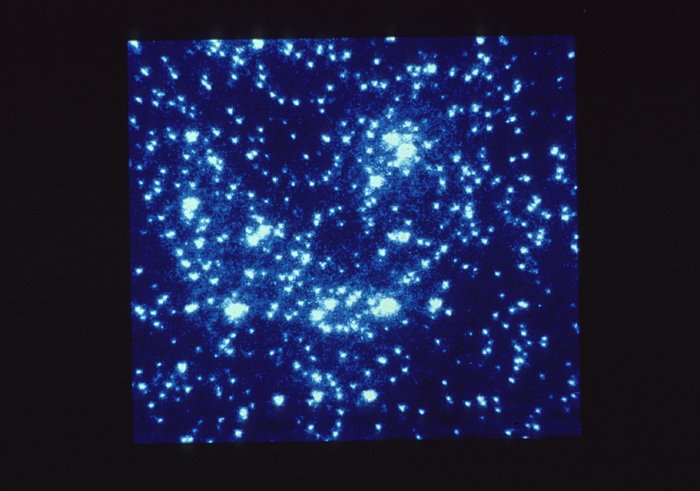 47 Tucanae coreJuly 24, 1991
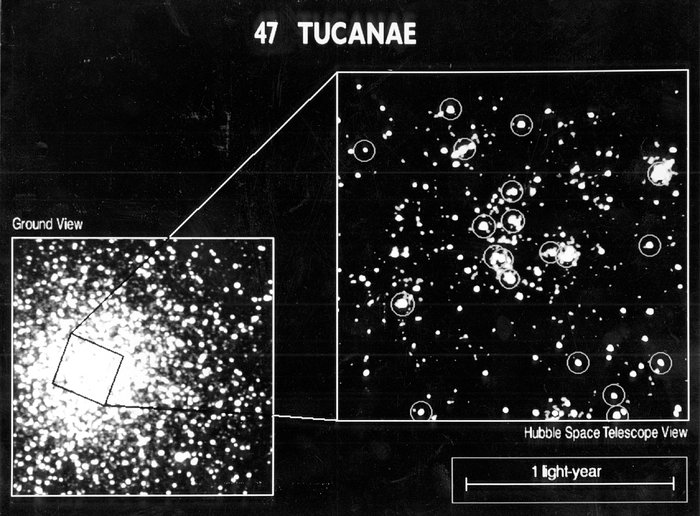 47 Tucanae core - ground based vs. HST resolutionJuly 24, 1991