
Nebulae
Light Echo from Star V838 Monocerotis
March 26, 2003 · NASA · V838 Monocerotis, V838 Mon · Monoceros
Zoom to full resolution See where it is in the 3D sky Original on NASA ↗
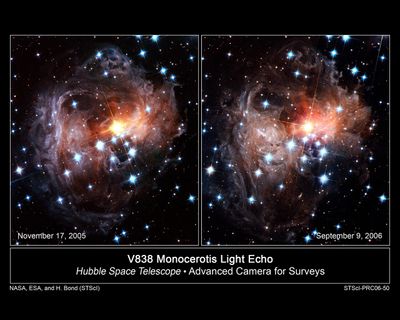
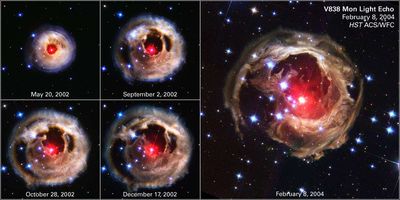
This sequence of pictures from the NASA Hubble Space Telescope's Advanced Camera for Surveys dramatically demonstrates the reverberation of light through space caused by an unusual stellar outburst in January 2002. A burst of light from the bizarre star is spreading into space and reflecting off of surrounding shells of dust to reveal a spectacular, multicolored bull's eye.
This sequence of pictures from May to December 2002 shows apparent changes in the appearance of the circumstellar dust as different parts are illuminated sequentially. This effect is called a "light echo." From the first to last image the apparent diameter of the nebula appears to balloon from 4 to 7 light-years. This gives the illusion that the dust is expanding into space faster than the speed of light. In reality the dust shells are not expanding at all, but it is simply the light from the stellar flash that is sweeping out into the nebula. The different colors in the nebula reflect changes in the color of the star during its outburst.
The red star at the center of the eyeball-like feature is an unusual erupting supergiant called V838 Monocerotis, located about 20,000 light-years away in the winter constellation Monoceros (the Unicorn). During its outburst the star brightened to more than 600,000 times our Sun's luminosity.
The circular feature has now expanded to slightly larger than the angular size of Jupiter on the sky. For several more years it will continue expanding as reflected light arrives from more distant portions of the nebula. Eventually, when light from the back side of the nebula begins to arrive, the light echo will give the illusion of contracting, and finally it will disappear by the end of this decade. The black gaps around the red star are regions of space where there are holes in dust. This shows the nebula has a Swiss-cheese structure.
About the data
These data are from the HST archived proposals 9587 , 9588 , and 9694 .
The science team is composed of: H.E. Bond (STScI), A. Henden (USNO), Z. Levay (STScI), N. Panagia (STScI), W. Sparks (STScI), S. Starrfield (Arizona State Univ.), R.M. Wagner (LBTO), R.L.M. Corradi (ING), U. Munari (INAF).
More Hubble images of V838 Monocerotis, V838 Mon
 Hubble’s Latest Views of Light Echo from Star V838 MonocerotisOctober 26, 2006
V838 Monocerotis – November 2005October 26, 2006
V838 Monocerotis – September 2006October 26, 2006
Close-Up of Light Echo Around V838 Monocerotis (September 2006)October 26, 2006
“Light Echo” Illuminates Dust Around Supergiant Star V838 Monocerotis (V838 Mon)March 4, 2004
 Expanding Flash From Supergiant Star V838 Monocerotis (V838 Mon)March 4, 2004
Star V838 Monocerotis (V838 Mon) – May 20, 2002March 4, 2004
Star V838 Monocerotis (V838 Mon)- September 2, 2002March 4, 2004