
Black holes
Our Neighboring Galaxy’s Unusual Core
September 20, 2005 · NASA · M31, Andromeda Galaxy, NGC 224 · Andromeda
Zoom to full resolution See where it is in the 3D sky Original on NASA ↗
The images and illustration reveal that the Andromeda Galaxy's (M31's) core is composed of a ring of old, red stars and a newly discovered disk of young, blue stars. The disk is trapped within a supermassive black hole's gravitational field. The mass of Andromeda's monster black hole is 140 million times greater than that of our Sun.
The illustration at bottom, right shows the structure of Andromeda's unusual core and is based on Hubble images of the region. The disk of blue stars is nested inside the larger ring of red stars. The tiny black dot within the blue disk is the monster black hole.
Astronomers deduced the structure of Andromeda's core from Hubble images taken over the past decade. The image at upper, right, taken with the Wide Field and Planetary Camera 2, shows that the galaxy appears to have two cores. Normal galaxies only have one core. Astronomers now believe
that Andromeda has one core. The two bright blobs are actually the ring of red stars and the disk of blue stars. In fact, the bright blob on the right has a bluish cast.
The image at left is a view of the entire Andromeda Galaxy. The active core is in the center of the galaxy. Andromeda is 2.5 million light-years from Earth.
About the data
The WFPC2 science data are from the HST proposal 5236 : J. Westphal (Caltech), T.R. Lauer (NOAO/AURA/NSF), S. M. FABER UCO/Lick Observatory, W. Baum (Univ. of Washington)
The STIS science data are from the HST proposal 8018: R. Green (NOAO/KPNO) and G. Bower (NOAO).
The science team includes: R. Bender (Univ. of Sternwarte, Munich; Max Planck Inst., Garching; Univ. of Texas at Austin), J. Kormendy (Univ. of Texas at Austin), G. Bower (CSC/STScI), R. Green (NOAO), J. Thomas (Univ. of Sternwarte, Munich; Max Planck Inst., Garching), A.C. Danks (Bowie, MD), T. Gull (NASA/GSFC), J.B. Hutchings (NRC of Canada), C.L. Joseph (Rutgers Univ.), M.E. Kaiser (JHU), T.R. Lauer (NOAO/AURA/NSF), C.H. Nelson (UNLV), D. Richstone (Univ. of Michigan), D. Weistrop (UNLV), and B. Woodgate (NASA/GSFC).
More Hubble images of M31, Andromeda Galaxy, NGC 224
Hubble M31 PHAT+PHAST MosaicJanuary 16, 2025
Hubble M31 PHAT MosaicJanuary 5, 2015
Hubble M31 PHAT Mosaic (Uncropped)January 5, 2015
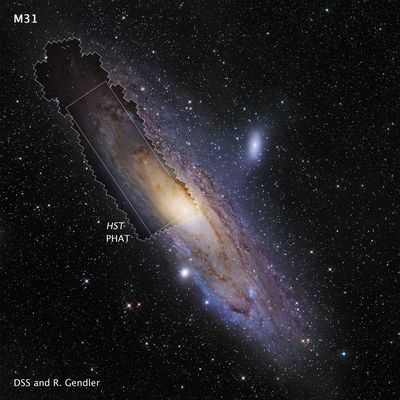 Hubble M31 PHAT Mosaic in Ground-based Image of M31January 5, 2015
Andromeda’s Active CoreSeptember 20, 2005
Andromeda Galaxy (M31) Wide-Field ImageSeptember 20, 2005
The Core of the Andromeda Galaxy (M31)September 20, 2005
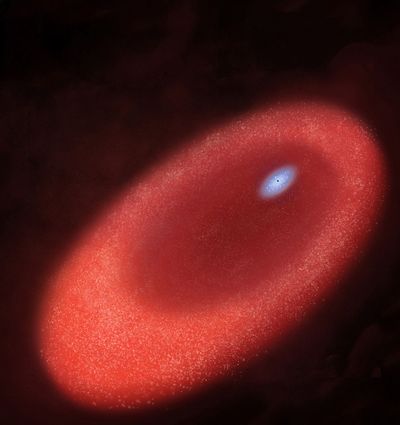 Artist’s Rendition of the Core of M31September 20, 2005