![A Gallery of Einstein Rings ([Top row - left to right] J073728.45+321618.5, J095629.77+510006.6…) — image from the Hubble Space Telescope](https://assets.science.nasa.gov/dynamicimage/assets/science/missions/hubble/releases/2005/11/STScI-01EVVM6VGK8B31GGMRPTDWD986.jpg?w=1600&fit=clip)
Deep fields & lensing
A Gallery of Einstein Rings
November 17, 2005 · NASA · [Top row - left to right] J073728.45+321618.5, J095629.77+510006.6…
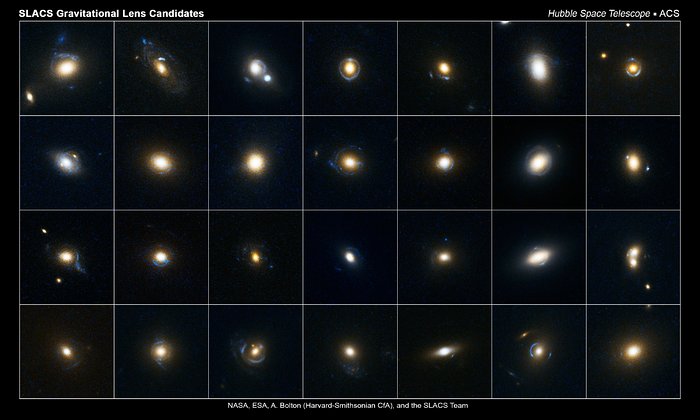
The thin blue bull's-eye patterns in these eight Hubble Space Telescope images appear like neon signs floating over reddish-white blobs. The blobs are giant elliptical galaxies roughly 2 to 4 billion light-years away. The bull's-eye patterns are created as the light from galaxies twice as far away is distorted into circular shapes by the gravity of the giant elliptical galaxies. This phenomenon is called gravitational lensing, first predicted by Albert Einstein almost a century ago. Gravitational lensing occurs when the gravitational field from a massive object warps space and deflects light from a distant object behind it.
The bull's-eye patterns are so-called "Einstein rings," which are the most elegant manifestation of the lensing phenomenon. Einstein rings are produced when two galaxies are almost perfectly aligned, one behind the other.
The images were taken between August 2004 and March 2005 by the Hubble telescope's Advanced Camera for Surveys. They are part of an ongoing survey, called the Sloan Lens ACS (or SLACS) Survey, of about 150 galaxies to hunt for gravitational lenses. So far, the survey has netted 19 new gravitational lenses, adding significantly to the 100 or so previously known lenses. The survey also has identified eight new Einstein rings. Only three such rings had been seen previously in visible light.
About the colours
F435W (B) and F814W (I)
About the data
The Hubble image was created from HST data from proposal 10174 . Members of the SLACS team include: A. Bolton (Harvard-Smithsonian CfA), S. Burles (Massachusetts Institute of Technology), L. Koopmans (Kapteyn Astronomical Institute), T. Treu (University of California - Santa Barbara), and L. Moustakas (Jet Propulsion Lab/Caltech).
More deep fields & lensing
A Gallery of ‘Tadpole Galaxies’January 10, 2006
 Locate the ‘Tadpole’ GalaxiesJanuary 10, 2006
 Einstein Ring Gravitational Lens: SDSS J095629.77+510006.6November 17, 2005
 Slacs gravitational lens candidatesNovember 17, 2005
Einstein Ring Gravitational Lens (SDSS J073728.45+321618.5)November 17, 2005
Einstein Ring Gravitational Lens (SDSS J095629.77+510006.6)November 17, 2005
Einstein Ring Gravitational Lens (SDSS J120540.43+491029.3)November 17, 2005
Einstein Ring Gravitational Lens (SDSS J125028.25+052349.0)November 17, 2005