
Star clusters
Stellar Sorting in Globular Cluster 47 Tucanae
October 24, 2006 · NASA · 47 Tucanae, NGC 104 · Tucana
Zoom to full resolution See where it is in the 3D sky Original on NASA ↗
NASA's Hubble Space Telescope has provided astronomers with the best observational evidence to date that globular clusters sort out stars according to their mass, governed by a gravitational billiard ball game between stars. Heavier stars slow down and sink to the cluster's core, while lighter stars pick up speed and move across the cluster to its periphery.
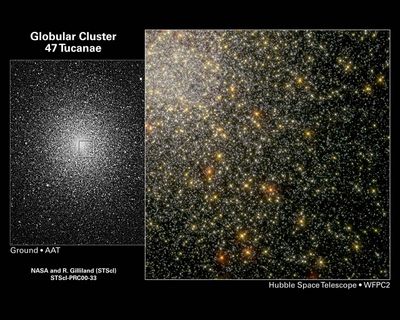
[Left] - A photo of the globular star cluster 47 Tucanae taken with the Very Large Telescope in Chile. It is one of the densest globular clusters in the Southern Hemisphere. The cluster contains 1 million stars.
[Right] - A NASA Hubble Space Telescope color photo of the core of 47 Tucanae. Multiple photos of this region allowed astronomers to track the "behive swarm" motion of stars. Precise velocities were obtained for nearly 15,000 stars in this cluster. This image was taken with Hubble's Advanced Camera for Surveys.
The international science team was made of the following scientists: D.E. McLaughlin (University of Leicester), J. Anderson (Rice University), G. Meylan (Ecole Polytechnique Federale de Lausanne), K. Gebhardt (University of Texas at Austin), C. Pryor (Rutgers University), D. Minniti (Pontifica Universidad Catolica), and S. Phinney (Caltech).
About the colours
The Hubble image is a composite of many separate exposures made by the ACS instrument on the Hubble Space Telescope using three different filters to sample broad wavelength ranges. The color results from assigning different hues (colors) to each monochromatic image. In this case, the assigned colors are: Blue: F475W (SDSS g) Green: F555W (V) Red: F814W (I)
About the data
The Hubble image was created from data from the following proposals: 5912 , 6467 , and 7503 : G. Meylan (Ecole Polytechnique Federale de Lausanne), D. Minniti (Universidad Catolica de Chile), S. Phinney (California Institute of Technology), C. Pryor (Rutgers University), B. Sams (Mediateam, Germany), and C. Tinney (Anglo-Australian Observatory)
8267 : R. Gilliland (STScI), D. Naef (Observatoire de Geneve), A. Sarajedini (University of Florida), S. Sigurdsson (Pennsylvania State University), D. VandenBerg (University of Victoria), T. Brown (University Corporation For Atmospheric Research), A. Burrows (University of Arizona), W. Cochran (University of Texas, Austin), P. Edmonds (Harvard University), S. Frandsen (Aarhus University), S. Vogt, P. GuhaThakurta, and D. Lin (University of California, Santa Cruz), G. Marcy (University of California, Berkeley), M. Mayor (Observatoire de Geneve), and E. Milone (University of Calgary)
9019 : R. Bohlin (STScI), G. De Marchi (ESA/STScI), and R. Gilliland (STScI)
9266 : R. Gilliland, K. Sahu, and P. Goudfrooij (STScI)
9028 : G. Meurer and H. Tran (Johns Hopkins University)
9443 : I. King (University of Washington) and J. Anderson (Rice University)
The international team was made of the following scientists: D.E. McLaughlin (University of Leicester), J. Anderson (Rice University), G. Meylan (Ecole Polytechnique Federale de Lausanne), K. Gebhardt (University of Texas, Austin), C. Pryor (Rutgers University), D. Minniti (Pontifica Universidad Catolica), and S. Phinney (Caltech).
More Hubble images of 47 Tucanae, NGC 104
 Central regions of 47 TucanaeMay 14, 2015
 Central regions of 47 Tucanae seen in the ultravioletMay 14, 2015
Very Large Telescope Image of 47 TucanaeOctober 24, 2006
Hubble Space Telescope (ACS) Image of 47 TucanaeOctober 24, 2006
 Hubble Sees a Vast “City” of StarsOctober 31, 2000
Globular Cluster 47 Tucanae, Home to 35,000 StarsOctober 31, 2000
47 TucanaeOctober 31, 2000
 Rejuvenated Stars, called “Blue Stragglers,” in Globular Cluster 47 Tucanae (left)October 29, 1997