
Exoplanets
SWEEPS ACS/WFC Color Composite
October 4, 2006 · NASA · SWEEPS Field · Sagittarius
Zoom to full resolution See where it is in the 3D sky Original on NASA ↗
Color composite of ACS/WFC images (V and I band filters) showing one-half of the Hubble Space Telescope field of view in the Sagittarius Window Eclipsing Extrasolar Planet Search (SWEEPS). The stars in the Galactic disk and bulge have a mixture of colors and masses. The field is so crowded with stars because Hubble was looking across 26,000 light-years of space in the direction of the center of our galaxy.
Half of these stars are bright enough for Hubble to monitor for any small, brief and periodic dips in brightness caused by the passage of an exoplanet passing in front of the star, an event called a transit. Hubble took approximately 520 pictures of this field, at red and blue wavelengths, from Feb. 22-29, 2004.
About the colours
This image is a composite of many separate exposures made by the ACS instrument on the Hubble Space Telescope using two different filters. Two filters were used to sample broad wavelength ranges. The color results from assigning different hues (colors) to each monochromatic image. In this case, the assigned colors are: Blue: F606W (V) Green: F606W (V) + F814W (I) Red: F814W (I)
About the data
This image was created from HST data from proposal 9750 : K. Sahu, and H. Bond (STScI), T. Brown (High Altitude Observatory, Boulder), S. Casertano and M. Livio (STScI), D. Minniti (Catholic University of Chile), N. Panagia (STScI), A. Renzini (Astronomical Observatory of Padova, Italy), R. Rich (University of California, Los Angeles), and M. Zoccali (Catholic University of Chile). The science team also includes J. Valenti, E. Smith, T. Brown, W. Clarkson, and S. Lubow (STScI), and N. Piskunov (Uppsala University, Sweden).
More Hubble images of SWEEPS Field
 White Dwarf Stars in the Milky Way BulgeNovember 5, 2015
 Survey of White Dwarf Stars in the Milky Way BulgeNovember 5, 2015
Sample of White Dwarfs in the Hubble SWEEPS FieldNovember 5, 2015
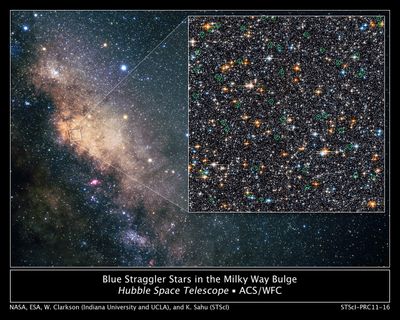 Hubble Finds Blue Straggler Stars in the Galactic BulgeMay 25, 2011
Hubble ACS SWEEPS FieldMay 25, 2011
 Hubble Exoplanet Search Field in SagittariusOctober 4, 2006
Detail of SWEEPS ACS/WFC Color CompositeOctober 4, 2006
 SWEEPS 16 Extrasolar Planet CandidatesOctober 4, 2006