
Deep fields & lensing
Hubble Observes Infant Stars in Nearby Galaxy
January 8, 2007 · NASA · NGC 602, N90 · Tucana
Zoom to full resolution See where it is in the 3D sky Original on NASA ↗
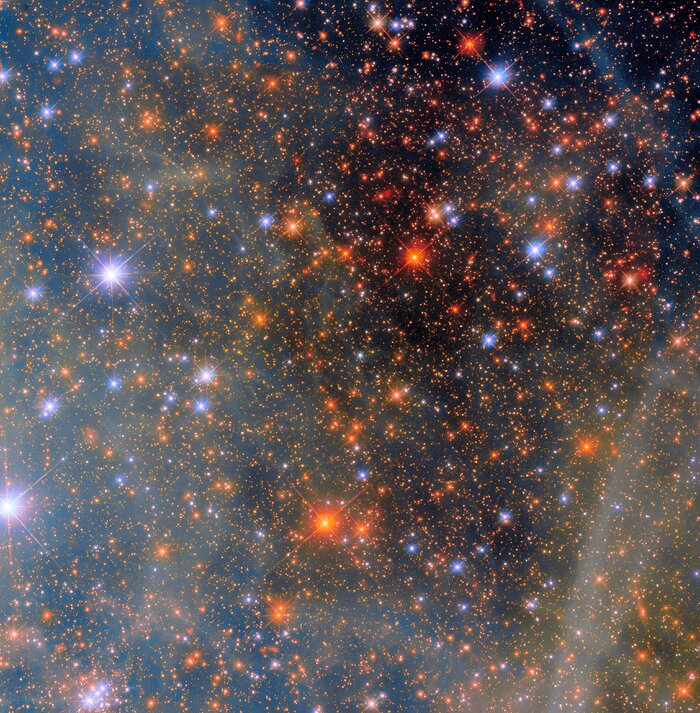
This new image taken with NASA's Hubble Space Telescope depicts bright, blue, newly formed stars that are blowing a cavity in the center of a star-forming region in the Small Magellanic Cloud.
At the heart of the star-forming region, lies star cluster NGC 602. The high-energy radiation blazing out from the hot young stars is sculpting the inner edge of the outer portions of the nebula, slowly eroding it away and eating into the material beyond. The diffuse outer reaches of the nebula prevent the energetic outflows from streaming away from the cluster.
Ridges of dust and gaseous filaments are seen towards the northwest (in the upper-left part of the image) and towards the southeast (in the lower right-hand corner). Elephant trunk-like dust pillars point towards the hot blue stars and are tell-tale signs of their eroding effect. In this region it is possible with Hubble to trace how the star formation started at the center of the cluster and propagated outward, with the youngest stars still forming today along the dust ridges.
The Small Magellanic Cloud, in the constellation Tucana, is roughly 200,000 light-years from the Earth. Its proximity to us makes it an exceptional laboratory to perform in-depth studies of star formation processes and their evolution in an environment slightly different from our own Milky Way.
Dwarf galaxies such as the Small Magellanic Cloud, with significantly fewer stars compared to our own galaxy, are considered to be the primitive building blocks of larger galaxies. The study of star formation within this dwarf galaxy is particularly interesting to astronomers because its primitive nature means that it lacks a large percentage of the heavier elements that are forged in successive generations of stars through nuclear fusion.
These observations were taken with Hubble's Advanced Camera for Surveys in July 2004.
Filters that isolate visible and infrared light were combined with a filter that samples the hydrogen and nitrogen emission from the glowing clouds.
About the colours
This image is a composite of many separate exposures made by the ACS instrument on the Hubble Space Telescope using several different filters. Two filters were used to sample broad wavelength ranges. One filter was used to sample narrow wavelength emission. The color results from assigning different hues (colors) to each monochromatic image. In this case, the assigned colors are: Blue: F555W (V) Green: F555W (V) + F814W (I) Red: F658N (Halpha+[N II]) + F814W (I)
About the data
The Hubble image was created from HST data from proposal 10248 : A. Nota (STScI/ESA), M. Sirianni (STScI/ESA), E. Sabbi (University of Bologna), M. Tosi (INAF - Bologna Observ.), J. Gallagher (University of Wisconsin), M. Meixner (STScI), M. Clampin (Goddard Space Flight Center), S. Oey (University of Michigan), A. Pasquali (ETH, Zurich), L. Smith (University College London), and R. Walterbos (New Mexico State University). The science team also includes L. Carlson (Johns Hopkins University).
More Hubble images of NGC 602, N90
Taken Under the “Wing” of the Small Magellanic CloudApril 4, 2013
 Star Cluster NGC 602January 8, 2007
 Hubble Spots Stellar Sculptors in NGC 346April 4, 2025
 Colourful clouds of a nearby neighbourMarch 17, 2025
 A dynamic duo … or trio?October 23, 2023
 Head in the CloudsDecember 5, 2022
 NGC 346September 8, 2022
 Four Filter FusionDecember 6, 2021