
Deep fields & lensing
A Sky Flush with Galaxies
March 6, 2007 · NASA · Extended Groth Strip (EGS) · Ursa Major
Zoom to full resolution See where it is in the 3D sky Original on NASA ↗
This image, taken by NASA's Hubble Space Telescope, represents a small section of a larger panoramic view of the heavens, where at least 50,000 galaxies reside.
The cosmic tapestry unveils galaxies in all shapes, sizes, and colors. Some of the galaxies are nearby; the smaller ones are far away and existed when the universe was only a small fraction of its current age of roughly 14 billion years.
The Hubble observation, made with the Advanced Camera for Surveys, is part of the All-wavelength Extended Groth Strip International Survey, a collaborative effort using major ground-based and space-based telescopes to focus on a narrow swath of sky near the Big Dipper. The region offers a clear view of the distant universe.
Astronomers studying the Groth Strip find that star formation is largely driven by the supply of raw materials, such as gas and dust, collapsing under the force of gravity. More massive galaxies form stars early, whereas the smaller galaxies create their stars over longer timescales. Both normal-looking, undisturbed galaxies and those showing signs of catastrophic collisions were forming an abundance of stars 8 billion years ago. This evidence suggests that violent galaxy mergers were not required for rapid star formation.
The Groth Strip is an extension of an original survey of part of the same region executed in 1994 by Princeton University astronomer Edward J. Groth, who created a mosaic of 28 overlapping fields with the Hubble Wide Field Planetary Camera 2.
The Advanced Camera for Surveys image was taken from June 2004 to March 2005.
About the colours
This image is a composite of many separate exposures made by the WFPC2 instrument on the Hubble Space Telescope using two different filters to sample broad wavelength ranges. The color results from assigning different hues (colors) to each monochromatic image. In this case, the assigned colors are: Blue: F606W (V) Green: F606W (V) + F814W (I) Red: F814W (I)
About the data
The Hubble image was created from HST data from proposal 10134 : M. Davis (University of California, Berkeley), M. Ashby (Harvard-Smithsonian Center for Astrophysics), T. Small (California Institute of Technology), P. Guhathakurta (University of California, Santa Cruz), L. Simard (Dominion Astrophysical Observatory), K. Noeske (University of California, Santa Cruz), S. Kwok, J. Mader, and P. Amico (California Association for Research in Astronomy (CARA)), A. Koekemoer and R. Somerville (STScI), S. Faber (University of California, Santa Cruz), J. Newman (Lawrence Berkeley National Laboratory), D. Koo (University of California, Santa Cruz), S. White, G. Kauffmann, and V. Springel (Max Planck Institute for Astrophysics, Garching), M. Cooper (University of California, Berkeley), A. Metevier and B. Weiner (University of California, Santa Cruz), and K. Bundy (California Institute of Technology).
More Hubble images of Extended Groth Strip (EGS)
Extended Groth StripOctober 27, 2011
Extended Groth Strip – Detail of Hubble ImageApril 21, 2009
Extended Groth Strip – Detail of Hubble ImageApril 24, 2007
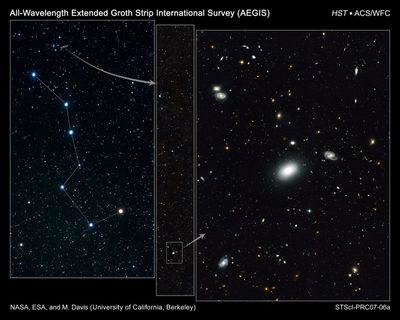 A Panoramic View of the SkyMarch 6, 2007
Extended Groth Strip – Full Hubble ImageMarch 6, 2007
Extended Groth Strip – Detail of Hubble ImageMarch 6, 2007
 M82 Cigar Galaxy (Webb + Hubble)June 23, 2026
 Cloud 9, Starless Gas CloudJanuary 5, 2026