
Nebulae
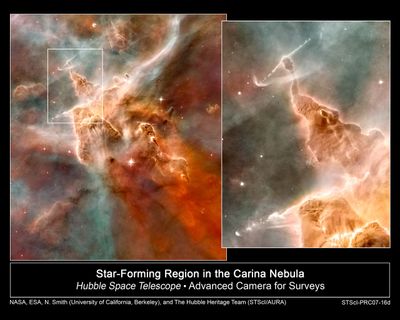
Star-Forming Region in the Carina Nebula: Detail 1
April 24, 2007 · NASA · Mystic Mountain, HH 901 and HH 902 in the Carina Nebula, NGC 3372 · Carina
Zoom to full resolution See where it is in the 3D sky Original on NASA ↗
A towering "mountain" of cold hydrogen gas laced with dust is the site of new star formation in the Carina Nebula. The great gas pillar is being eroded by the ultraviolet radiation from the hottest newborn stars in the nebula.
About the colours
This image is a composite of many separate exposures made by the ACS instrument on the Hubble Space Telescope along with ground-based observations. In total, three filters were used to sample narrow wavelength emission. The color results from assigning different hues (colors) to each monochromatic image. In this case, the assigned colors are:Luminosity*: F658N (H-alpha+[N II])Blue: CTIO ([O III] 501nm)Green: CTIO (H-alpha+[N II] 658nm)Red: CTIO ([S II] 672+673nm)*The higher resolution, black & white Hubble image and the lower resolution, color CTIO images were combined using a technique that takes luminosity (brightness) information from the black and white ACS image and color information from the composite CTIO image. This preserves all of the higher-resolution detail from the Hubble data while rendering a color image representing the physical processes in this active region of space.
About the data
This color image combines many exposures from Hubble Space Telescope's Advanced Camera for Surveys (ACS)* and NOAO/AURA/NSF Cerro-Tololo Interamerican Observatory's (CTIO) 4m Blanco Telescope and MOSAIC2 camera. The ACS data was from the HST proposal 10241 : N. Smith (University of California, Berkeley), J. Bally (University of Colorado at Boulder), N. Walborn (STScI), and J. Morse (NASA/GSFC). *A small area of the Hubble ACS image that was saturated around the brightest star in the field, Eta Carinae, was replaced with images from previous shorter exposures from Hubble's Wide Field Planetary Camera 2.
The CTIO observing team includes: N. Smith (University of California, Berkeley), J. Bally (University of Colorado at Boulder), and J. Walawender (Institute for Astronomy/University of Hawaii). *A small area of the Hubble ACS image that was saturated around the brightest star in the field, Eta Carinae, was replaced with images from previous shorter exposures from Hubble's Wide Field Planetary Camera 2.
More Hubble images of Mystic Mountain, HH 901 and HH 902 in the Carina Nebula, NGC 3372
 Star-Forming Region in the Carina NebulaApril 24, 2007
Star-Forming Region in the Carina Nebula: Detail 2April 24, 2007
 A broad and narrow galactic viewJune 3, 2024
 A Closer Look at Hubble’s 31st Anniversary SnapshotSeptember 13, 2021
 A Closer Look at Hubble’s 31st Anniversary SnapshotSeptember 13, 2021
 Hubble Celebrates its 31st anniversary with a magnificent view of AG CarinaeApril 23, 2021
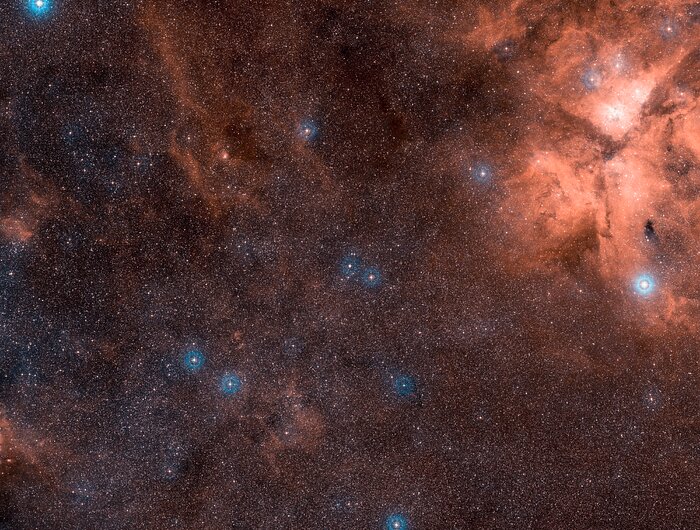 Wide-Field View of AG CarinaeApril 23, 2021
AG CarinaeApril 23, 2021