
Star clusters
Globular Cluster with Multiple Stellar Populations
May 2, 2007 · NASA · NGC 2808 · Carina
Zoom to full resolution See where it is in the 3D sky Original on NASA ↗
This Hubble telescope image of a dense swarm of stars shows the central region of the globular cluster NGC 2808.
Astronomers were surprised when Hubble spied three generations of cluster stars. The discovery is far different from the standard picture of a globular cluster. For decades, astronomers thought that cluster stars formed at the same time, in the same place, and from the same material, and have co-evolved for billions of years.
Globular clusters are the homesteaders of our Milky Way Galaxy, born during our galaxy's formation. They are compact swarms of typically hundreds of thousands of stars held together by gravity.
All the stars in NGC 2808 were born within 200 million years very early in the life of the 12.5-billion-year-old massive cluster. Of the about 150 known globular clusters in our Milky Way Galaxy, NGC 2808 is one of the most massive, containing more than 1 million stars.
The sharp resolution of Hubble's Advanced Camera for Surveys measured the brightness and colors of the cluster stars to find the three stellar populations.
The Hubble images were taken in May 2005 and in August and November 2006.
The science team includes G. Piotto, A.P. Milone, and S. Villanova (University of Padua [Padova]), L.R. Bedin (European Space Agency, European Organization for Astronomical Research in the Southern Hemisphere, and Space Telescope Science Institute), J. Anderson (Rice University), I.R. King (University of Washington), S. Cassisi and A. Pietrinferni (INAF- Astronomical Observatory of Collurania, Teramo), and A. Renzini (INAF-Astronomical Observatory of Padua [Padova]).
About the colours
This image is a composite of many separate exposures made by the ACS instrument on the Hubble Space Telescope. Two filters were used to sample light from broad wavelengths. The color results from assigning different hues (colors) to each monochromatic image. In this case, the assigned colors are: Blue: F475W (g) Green: F475W (g) + F814W (I) Red: F814W (I)
About the data
The ACS data were from the HST proposals: 9899 : G. Piotto (University of Padua [Padova]), I. King (University of Washington, Seattle), J. Anderson (Rice University), L. Bedin (ESA, European Organization for Astronomical Research in the Southern Hemisphere, and STScI), A. Renzini (Astronomical Observatory of Padua [Padova]), M. Zoccali (European Southern Observatory - Germany), Y. Momany (University of Padua [Padova]), A. Recio-Blanco (INAF/Astronomical Observatory of Rome), and F. De Angeli (University of Cambridge);
10922 : G. Piotto (University of Padua [Padova]), L. Bedin (ESA, European Organization for Astronomical Research in the Southern Hemisphere, and STScI), J. Anderson (Rice University), I. King (University of Washington, Seattle), S. Cassisi (INAF/Astronomical Observatory of Collurania, Teramo, Italy), and S. Villanova, Y. Momany, and A. Milone (University of Padua [Padova]).
The science team includes: G. Piotto (University of Padua [Padova]), L. Bedin (ESA, European Organization for Astronomical Research in the Southern Hemisphere, and STScI), J. Anderson (Rice University), I. King (University of Washington, Seattle), S. Cassisi and A. Pietrinferni (INAF/Astronomical Observatory of Collurania, Teramo, Italy), S. Villanova and A. Milone (University of Padua [Padova]), and A. Renzini (Astronomical Observatory of Padua [Padova]).
Note: Data for the release image of the center of the cluster were taken from the HST proposal 10775 : A. Sarajedini (University of Florida), N. Reid (Space Telescope Science Institute), S. Majewski (University of Virginia), B. Chaboyer (Dartmouth College), A. Aparicio (Astrophysical Institute of the Canaries), G. Piotto (University of Padua [Padova]), I. King (University of Washington, Seattle), J. Anderson (Rice University), R. Rosenberg (Astrophysical Institute of the Canaries), M. Siegel (Space Telescope Science Institute), and L. Bedin (ESA, European Organization for Astronomical Research in the Southern Hemisphere, and STScI).
More Hubble images of NGC 2808
 Triple Stellar Evolution Epochs in NGC 2808May 2, 2007
 A broad and narrow galactic viewJune 3, 2024
 A Closer Look at Hubble’s 31st Anniversary SnapshotSeptember 13, 2021
 A Closer Look at Hubble’s 31st Anniversary SnapshotSeptember 13, 2021
 Hubble Celebrates its 31st anniversary with a magnificent view of AG CarinaeApril 23, 2021
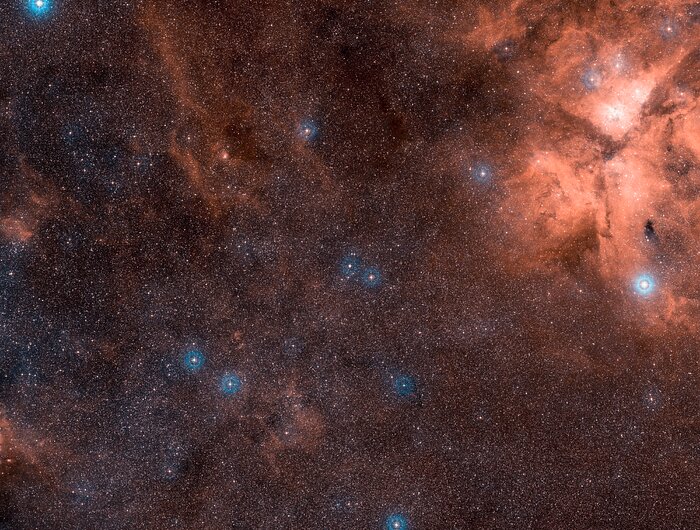 Wide-Field View of AG CarinaeApril 23, 2021
AG CarinaeApril 23, 2021
Westerlund 2May 28, 2020