
Deep fields & lensing
Trick of Nature Allows Hubble and Keck to Find Tiny Galaxy
October 4, 2007 · NASA · SDSS J0737+3216, SLACS J0737+3216 · Gemini
Zoom to full resolution See where it is in the 3D sky Original on NASA ↗
This photo illustration shows a tiny galaxy 6 billion light-years away that is smaller than any galaxy ever seen at that distance.
Astronomers discovered this distant galaxy through a phenomenon called gravitational lensing. This phenomenon occurs when a massive galaxy in the foreground bends the light rays from a distant galaxy behind it in much the same way as a magnifying glass does. When both galaxies are exactly lined up, the light forms a bull's-eye pattern, called an "Einstein ring," around the foreground galaxy.
This ring can be seen in the illustration. Einstein rings are named for physicist Albert Einstein, who predicted the phenomenon. By focusing the light rays, this gravitational lensing effect increases the observed brightness and size of the background galaxy by more than 10 times.
The illustration is based on images taken in infrared light from the W. M. Keck Telescope and visible-light images from NASA's Hubble Space Telescope. The Hubble and Keck data reveal information about the early years of the infant galaxy, namely that it is seen just after it formed most of its stars.
The Hubble images were taken on Nov. 5, 2006 with the Advanced Camera for Surveys and the Near Infrared Camera and Multi-Object Spectrometer. The Keck images were taken on Dec. 11, 2006.
About the data
The Hubble image was created from HST data from proposal 10494 : L. Koopmans (Kapteyn Astronomical Institute), T. Treu (University of California, Santa Barbara), A. Bolton (Institute for Astronomy/University of Hawaii), S. Burles (Massachusetts Institute of Technology), and L. Moustakas (Jet Propulsion Laboratory).
The science team includes: P. Marshall and T. Treu (University of California, Santa Barbara), J. Melbourne (U.C.O./Lick Observatory/Center for Adaptive Optics, University of California, Santa Cruz), R. Gavazzi (University of California, Santa Barbara), K. Bundy (University of Toronto), M. Ammons (U.C.O./Lick Observatory/Center for Adaptive Optics, University of California, Santa Cruz), A. Bolton (Institute for Astronomy/University of Hawaii), S. Burles (Massachusetts Institute of Technology), J. Larkin (University of California, Los Angeles), D. Le Mignant (W. M. Keck Observatory; Center for Adaptive Optics, University of California, Santa Cruz), D. Koo (U.C.O./Lick Observatory University of California, Santa Cruz), L. Koopmans (Kapteyn Astronomical Institute), and C. Max (U.C.O./Lick Observatory/Center for Adaptive Optics, University of California, Santa Cruz).
More Hubble images of SDSS J0737+3216, SLACS J0737+3216
Hubble/Keck Composite Image of Gravitational Lens System: SLACS J0737+3216October 4, 2007
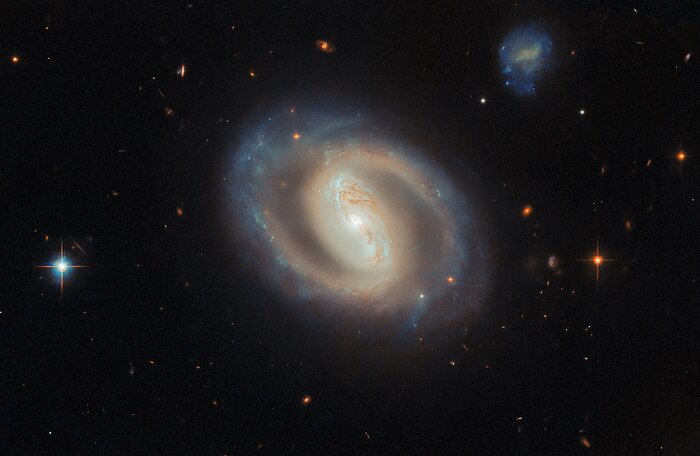 Where spiral arms and star formation meetMarch 27, 2026
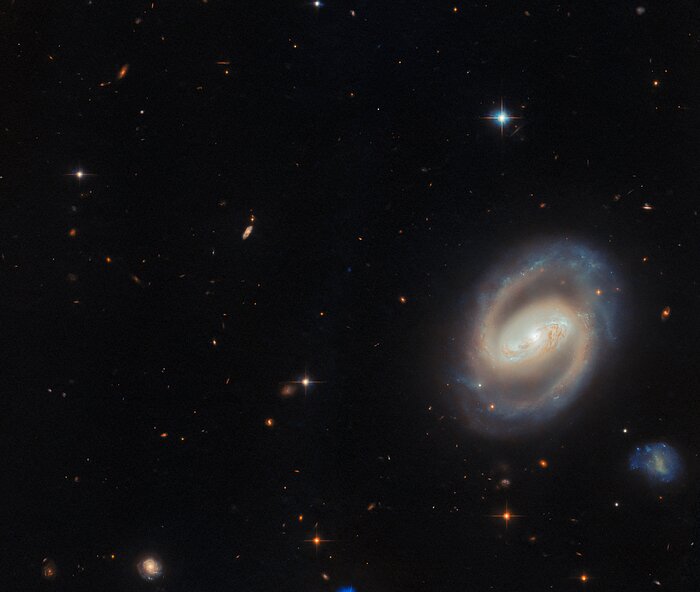 IC 486 (wide-field view)March 27, 2026
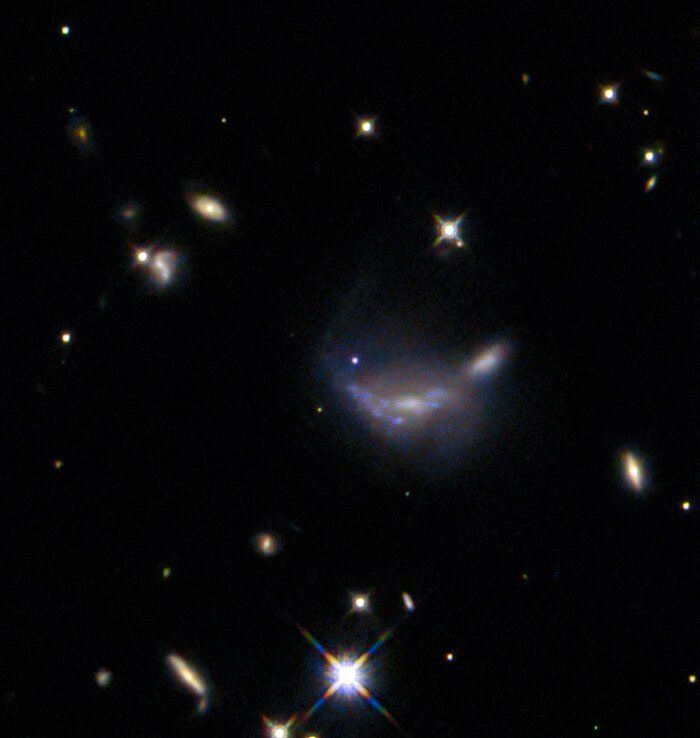 One in a hundredJanuary 27, 2025
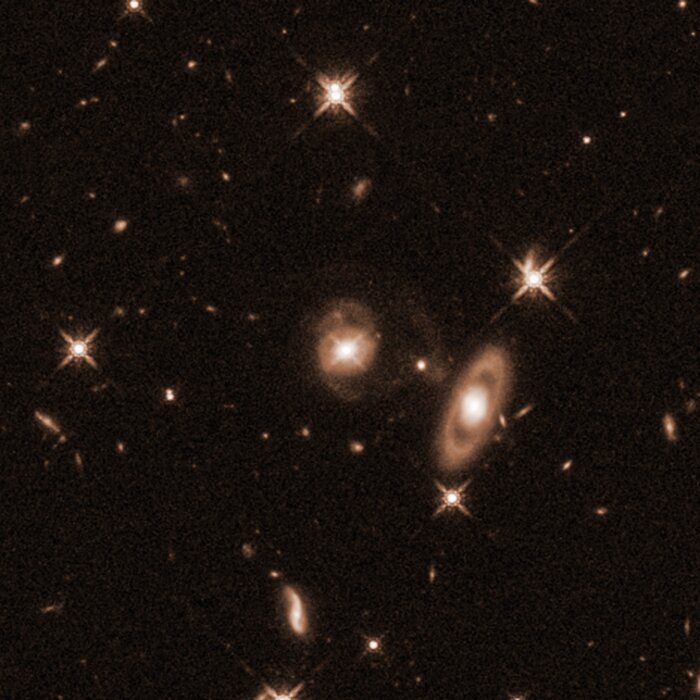 Quasar J0742+2704January 13, 2025
Spiral Quasar-host Galaxy J0742+2704January 13, 2025
 Pale blue (supernova) dotDecember 30, 2024
Dual Quasar (J0749+2255)April 5, 2023