
Black holes
Shells of Stars Ring Quasar in Giant Elliptical Galaxy
October 25, 2007 · NASA · MC2 1635+119, MC2 1635+11.9 · Hercules
Zoom to full resolution See where it is in the 3D sky Original on NASA ↗
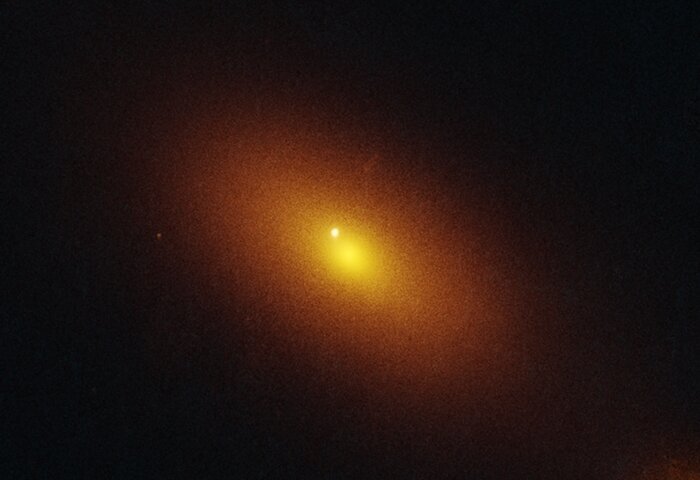
These sharp images taken with NASA's Hubble Space Telescope reveal at least five shells of stars surrounding a brilliant quasar at the heart of a giant elliptical galaxy. The image at left shows the quasar, known as MC2 1635+119, and its host galaxy [center] against a backdrop of distant galaxies. In the image at top,right, the shells can barely be seen because of the bright light from the central quasar.
The image at bottom, right was enhanced to reveal details of the faint shells. In both right-hand images, the objects below and to the left of the shells are background galaxies. A foreground star resides at top, left. The shells have never been seen before in this galaxy, located about 2 billion light-years away. They are evidence that the giant galaxy clashed with another galaxy in the relatively recent past. The shells are similar to ripples forming in a pond when a stone is tossed in. They sparkle with stars that were swept up from the encounter. The interaction may be providing enough fuel to power the quasar, which dominates the galaxy's center. This observation supports the idea that quasars are born from mergers between galaxies.
The images were taken June 28 and July 4, 2005 with Hubble's Advanced Camera for Surveys.
The observation team consists of Gabriela Canalizo and Nicola Bennert of the University of California, Riverside; Bruno Jungwiert of the University of California, Riverside/Astronomical Institute, Academy of Sciences of the Czech Republic, Prague; Alan Stockton of the University of Hawaii, Honolulu; Francois Schweizer of the Carnegie Observatories, Pasadena; Mark Lacy of the California Institute of Technology, Pasadena; and Chien Peng of the Space Telescope Science Institute, Baltimore.
About the data
The Hubble image was created from HST data from proposal 10421 : G. Canalizo (University of California, Riverside), A. Stockton (Institute for Astronomy/University of Hawaii), M. Lacy (Spitzer Science Center/California Institute of Technology), and F. Schweizer (Carnegie Observatories/Carnegie Institution of Washington).
The science team comprises: G. Canalizo and N. Bennert (University of California, Riverside), B. Jungwiert (University of California, Riverside/Astronomical Institute, Academy of Sciences of the Czech Republic, Prague), A. Stockton (Institute for Astronomy /University of Hawaii), F. Schweizer (Carnegie Observatories/Carnegie Institution of Washington), M. Lacy (Spitzer Science Center/California Institute of Technology), and C. Peng (STScI).
More Hubble images of MC2 1635+119, MC2 1635+11.9
Quasar MC2 1635+119 and Host GalaxyOctober 25, 2007
Quasar MC2 1635+119October 25, 2007
Quasar MC2 1635+119 (Enhanced)October 25, 2007
NGC 6099 (Hubble + Chandra)July 24, 2025
NGC 6099 (Hubble)July 24, 2025
 Hubble observes new tidal disruption event (January 2025 image)May 8, 2025
Black Hole TDE AT2024tvdMay 8, 2025
Black Hole TDE AT2024tvd (Hubble + Chandra)May 8, 2025