
Deep fields & lensing
Hubble Sees Double Einstein Ring
January 10, 2008 · NASA · SDSSJ0946+1006 · Leo
Zoom to full resolution See where it is in the 3D sky Original on NASA ↗
This is an image of gravitational lens system SDSSJ0946+1006 as photographed by Hubble Space Telescope's Advanced Camera for Surveys. The gravitational field of an elliptical galaxy warps the light of two galaxies exactly behind it. The massive foreground galaxy is almost perfectly aligned in the sky with two background galaxies at different distances. The foreground galaxy is 3 billion light-years away, the inner ring and outer ring are comprised of multiple images of two galaxies at a distance of 6 and approximately 11 billion light-years. The odds of seeing such a special alignment are estimated to be 1 in 10,000. The right panel is a zoom onto the lens showing two concentric partial ring-like structures after subtracting the glare of the central, foreground galaxy.
About the colours
The image is a composite of separate exposures made by the ACS instrument on the Hubble Space Telescope. A single filters was used to sample broad infrared wavelength ranges.
About the data
HST Proposal: 10886 A. Bolton (Institute for Astronomy, University of Hawaii/Harvard-Smithsonian Center for Astrophysics), T. Treu (University of California, Santa Barbara), S. Burles (Massachusetts Institute of Technology), L. Koopmans (Kapteyn Astronomical Institute, The Netherlands), and L. Moustakas (Jet Propulsion Laboratory/Caltech).
The science team comprises: R. Gavazzi and T. Treu (University of California, Santa Barbara), L. Koopmans (Kapteyn Astronomical Institute, The Netherlands), A. Bolton (Institute for Astronomy, University of Hawaii/Harvard-Smithsonian Center for Astrophysics), L. Moustakas (Jet Propulsion Laboratory/Caltech), S. Burles (Massachusetts Institute of Technology), and P. Marshall (University of California, Santa Barbara).
More Hubble images of SDSSJ0946+1006
Gravitational Lens System SDSSJ0946+1006 (Double Einstein Ring)January 10, 2008
Gravitational Lens System SDSSJ0946+1006 (Zoom onto Double Einstein Ring)January 10, 2008
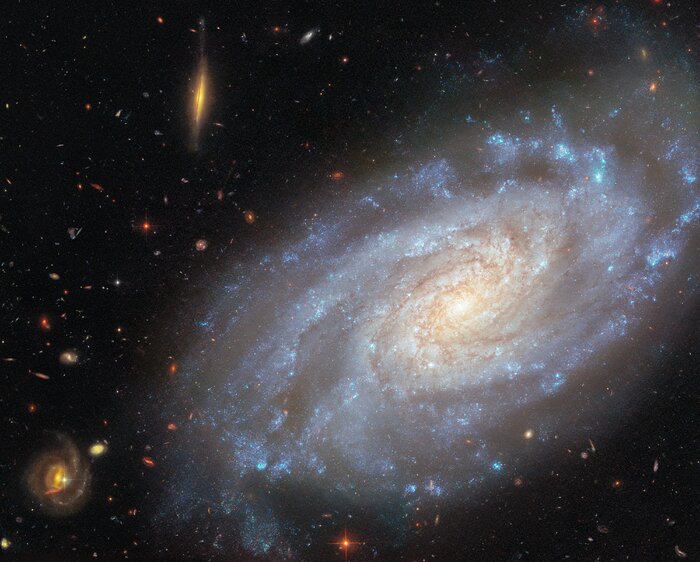 Focusing on NGC 3370October 20, 2025
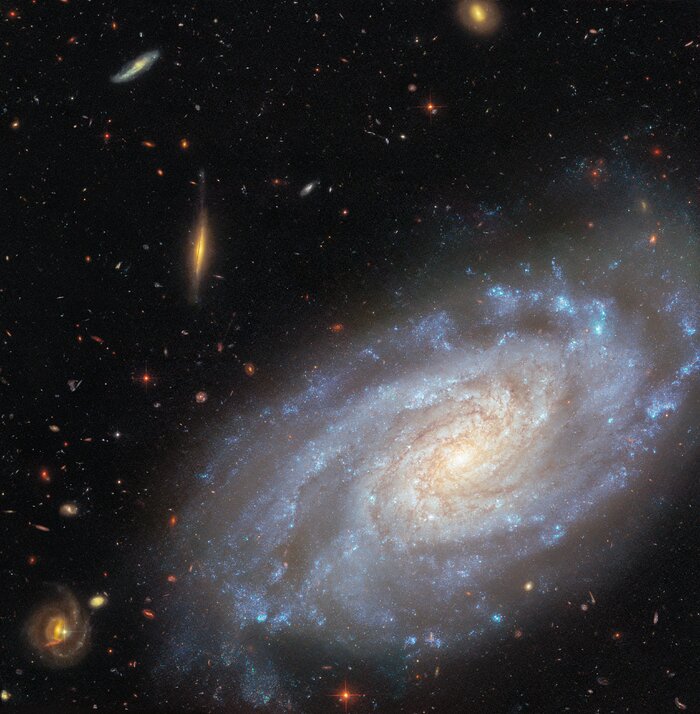 NGC 3370 (wide view)October 20, 2025
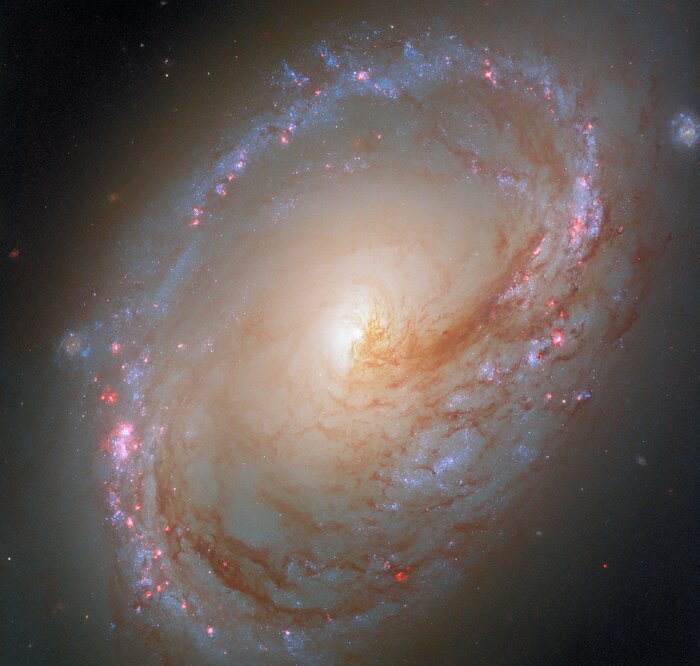 Taking a third lookAugust 25, 2025
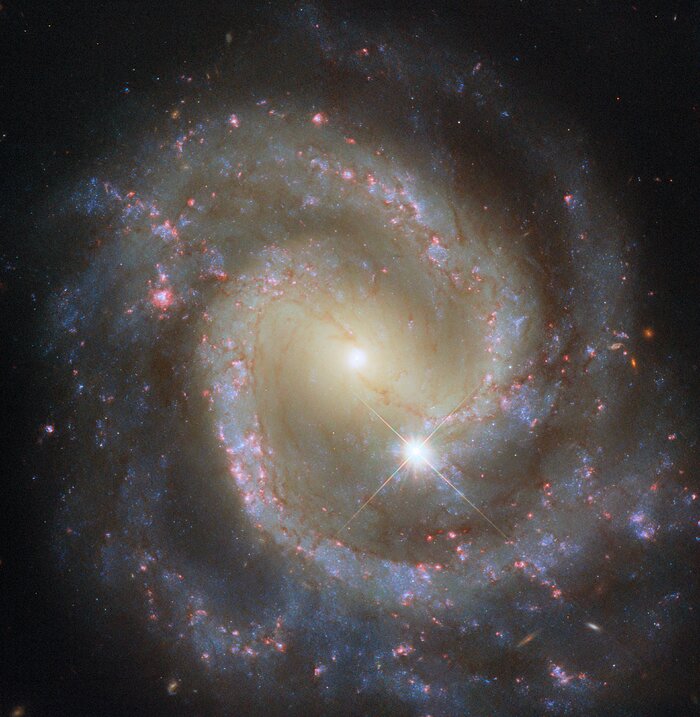 Paired pinwheel seen soloMay 26, 2025
 Face to face with a spiral’s armsMay 5, 2025
 The difference between distance and dustJuly 8, 2024