
Black holes
NGC 1275 (Perseus A) Multi-wavelength Composite
August 20, 2008 · NASA · NGC 1275, Perseus A, 3C 84 · Perseus
Zoom to full resolution See where it is in the 3D sky Original on NASA ↗
The active galaxy NGC 1275 is also a well-known radio source (Perseus A) and a strong emitter of X-rays due to the presence of a black hole in the center of the galaxy. The behemoth also lies at the center of the cluster of galaxies known as the Perseus Cluster. By combining multi-wavelength images into a single composite, the dynamics of the galaxy are more easily visible. Detail and structure from radio, optical and radio wavelengths combine for an aesthetically pleasing, but nonetheless violent depiction of events going on at the heart of the galaxy.
X-ray data from the Chandra's Advanced CCD Imaging Spectrometer and radio data from NRAO's Very Large Array were combined with optical wavelengths in the red, green and blue from Hubble's Advanced Camera for Surveys. In the composite image, the X-ray data contribute to the soft violet shells around the outside of the center. The pinkish lobes toward the center of the galaxy are from radio frequencies. The radio emission, tracing jets from the black hole, fills the X-ray cavities. Dust lanes, star-forming regions, hydrogen filaments, foreground stars, and background galaxies are contributions from the Hubble optical data.
More Hubble images of NGC 1275, Perseus A, 3C 84
Hubble ACS image of NGC 1275August 20, 2008
Freewheeling Galaxies Collide in a Blaze of Star Birth (NGC 1275)May 1, 2003
Full Image of Galaxy NGC 1275May 1, 2003
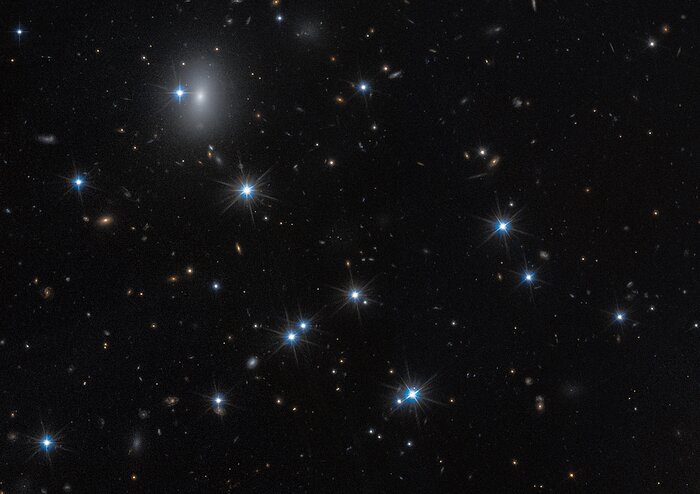 Galaxy field of low-surface-brightness galaxy CDG-2February 18, 2026
 Dark Galaxy CDG-2 Near Perseus ClusterFebruary 18, 2026
 Rings and thingsAugust 12, 2024
Little Dumbbell Nebula (WFC3 Image)April 23, 2024
NGC 1333April 20, 2023