
Deep fields & lensing
COSMOS Barred Spiral Galaxies
July 29, 2008 · NASA · COSMOS Field, Cosmological Evolution Survey Field · Sextans
Zoom to full resolution See where it is in the 3D sky Original on NASA ↗
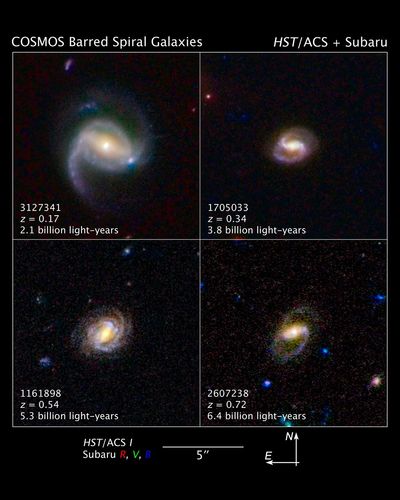
These images show four spiral galaxies with bars of stars and gas slicing through them.
The galaxies are at various distances from Earth. The galaxy at upper left is 2.1 billion light-years away; the galaxy at upper right, 3.8 billion light-years away; the galaxy at lower left, 5.3 billion light-years away; and the galaxy at lower right, 6.4 billion light-years away.
The galaxies are part of a landmark study of more than 2,000 spiral galaxies from the largest galaxy census conducted by the Advanced Camera for Surveys aboard NASA's Hubble Space Telescope.
The survey's results show that so-called barred spiral galaxies were far less plentiful over the last 7 billion years than they are today, in the local universe. The study's results confirm the idea that bars are a sign of galaxies reaching full maturity as the "formative years" end. The observations are part of the Cosmic Evolution Survey (COSMOS).
COSMOS covers an area of sky nine times larger than the full Moon, surveying 10 times more spiral galaxies than previous observations.
Astronomers assembled these images from observations taken with Hubble and the Subaru Telescope in Mauna Kea, Hawaii.
The observations were taken between fall 2003 and spring 2005.
About the colours
White: F814W (I) Blue: Suprime-Cam B Green: Suprime-Cam V Red: Suprime-Cam R
About the data
K. Sheth (Caltech), D. Elmegreen (Vassar College), B. Elmegreen (IBM/ T. J. Watson Center, NY), N. Scoville (Caltech), P. Capak, R. Ellis, M. Salvato, and L. Spalsbury (Caltech), R. Abraham (University of Toronto), E. Anthanassoula (Laboratoire d'Astrophysique de Marseille), B. Mobasher (University of California, Riverside), E. Schinnerer (Max Planck Institute for Astronomy, Heidelberg), L. Strubbe and A. West (University of California, Berkeley), M. Rich (University of California, Los Angeles), and M. Carollo (ETH Zurich).
Hubble data PI: Scoville: 9822 ; 10092 Hubble data PI: Taniguchi
More Hubble images of COSMOS Field, Cosmological Evolution Survey Field
 COSMOS Barred Spiral GalaxiesJuly 29, 2008
 Measure of a great galactic discSeptember 11, 2023
 A jellyfish and the ramApril 10, 2023
 A Waterfall of StarsNovember 2, 2020
 Up and OverJuly 22, 2019
 Warped and distortedSeptember 24, 2018
 Galactic refurbishmentApril 27, 2015
Global Temperature Map of WASP-43bOctober 9, 2014