
Deep fields & lensing
Hubble ACS Image of Elliptical Galaxy M87
August 5, 2008 · NASA · Virgo
Zoom to full resolution See where it is in the 3D sky Original on NASA ↗
The monstrous elliptical galaxy M87 is the home of several trillion stars, a supermassive black hole, and a family of 15,000 globular star clusters.
M87 is the dominant galaxy at the center of the neighboring Virgo cluster of galaxies, which contains some 2,000 galaxies.
Amid the smooth, yellow population of older stars, the two features that stand out most in this Hubble Space Telescope image of M87 are its soft blue jet and the myriad of starlike globular clusters scattered throughout the image.
The jet is a black-hole-powered stream of material that is being ejected from the core of the galaxy. As gaseous material from the center of the galaxy accretes onto the black hole, the resultant energy released produces a fire-hose stream of subatomic particles that are accelerated to velocities near the speed of light.
Being in the center of the Virgo cluster of galaxies, M87 may have accumulated some of its globular clusters by gravitationally pulling them from nearby dwarf galaxies that seem to be devoid of globulars today.
The 120,000-light-year-diameter galaxy lies at a distance of 54 million light-years from the Sun in the spring constellation Virgo.
This image was made from data taken in 2003 and 2006 with Hubble's Advanced Camera for Surveys. The image is a composite of individual filtered data that cover the visible and infrared portions of the spectrum.
About the colours
Blue: F475W (SDSS g)Green: F606W (V)Red: F814W (I)
About the data
HST Proposal: 9401 P. Cote (Herzberg Institute of Astrophysics, Victoria BC), J. Blakeslee (Dominion Astrophysical Observatory/Herzberg Institute of Astrophysics and Washington State University), L. Ferrarese (Herzberg Institute of Astrophysics, Victoria, BC), A. Jordan (Harvard-Smithsonian Center for Astrophysics), S. Mei (Observatoire Midi-Pyrenees), D. Merritt (Rochester Institute of Technology), M. Milosavljevic (California Institute of Technology), J. Tonry (University of Hawaii), E. Peng (Peking University, Beijing), and M. West (European Southern Observatory, Chile).
HST data also used from proposal 10543 : E. Baltz (Stanford University), T. Lauer (NOAO/AURA), A. Crotts (Columbia University), A. Gould (Ohio State University Research Foundation), P. Gondolo (University of Utah), M. Shara (American Museum of Natural History), J. Silk (University of Oxford), S. Zepf (Michigan State University), and D. Zurek (American Museum of Natural History).
More Hubble images of M87
M87September 26, 2024
 The Hubble and Keck Telescopes assemble a 3D view of a giant galaxyApril 13, 2023
Radio/X-ray/Optical Image of M87August 5, 2008
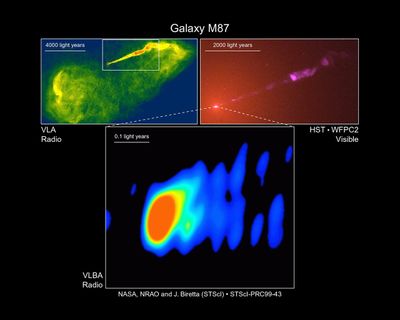 Close-Up Look at a Jet Near a Black HoleOctober 27, 1999
M87October 27, 1999
Black Hole in Galaxy M87 Emits Jet of High-Speed ElectronsOctober 27, 1999
M87October 27, 1999
Compact Core of Galaxy M87January 16, 1992