
Illustrations
Artist’s View of Exoplanet Orbiting the Star HD 189733
December 9, 2008 · NASA · HD 189733b · Vulpecula
Zoom to full resolution See where it is in the 3D sky Original on NASA ↗
This is an artist's impression of the Jupiter-size extrasolar planet, HD 189733b, being eclipsed by its parent star. Astronomers using the Hubble Space Telescope have measured carbon dioxide and carbon monoxide in the planet's atmosphere. The planet is a "hot Jupiter," which is so close to its star that it completes an orbit in only 2.2 days.
This type of observation is best done when the planet's orbit carries it behind the star (as seen from Earth), which allows an opportunity to subtract the light of the star alone (when the planet is blocked) from that of the star and planet together prior to eclipse. This allows astronomers to isolate the infrared emission of the planet and make spectroscopic observations that chemically analyze the day-side atmosphere.
The planet is too hot for life as we know it. But under the right conditions, on a more Earth-like world, carbon dioxide can indicate the presence of extraterrestrial life. This observation demonstrates that chemical biotracers can be detected by space telescope observations.
About the data
This science result was from HST data from proposal 10855 : M. Swain (NASA's Jet Propulsion Laboratory) and D. Deming (NASA Goddard Space Flight Center).
The science team includes: M. Swain, G. Vasisht , and P. Chen (NASA's Jet Propulsion Laboratory), G. Tinetti (University College London), J. Bouwman (Max-Planck Institute for Astronomy, Heidelberg), Y. Yung (California Institute of Technology), and D. Deming (NASA Goddard Space Flight Center).
More Hubble images of HD 189733b
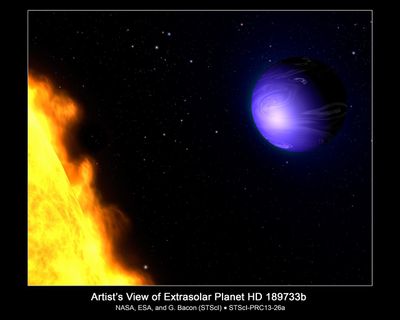 Artist’s View of Extrasolar Planet HD 189733bJuly 11, 2013
Exoplanet HD 189733b (Artist’s Illustration)June 28, 2012
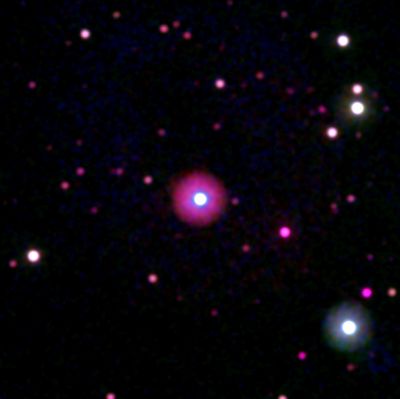 Swift Telescope View of Exoplanet HD 189733b’s Host StarJune 28, 2012
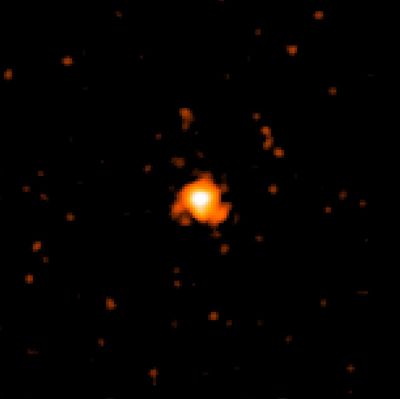 Swift X-ray Telescope View of Exoplanet HD 189733b’s Host StarJune 28, 2012
Illustration of Exoplanet Orbiting the Star HD 189733December 9, 2008
Artist’s View of Extrasolar Planet HD 189733bMarch 19, 2008
 Methane Absorption by the Atmosphere of Extrasolar Planet 189733bMarch 19, 2008
 Artist's impression of the hazy red sunset on HD 189733bDecember 11, 2007