
Star clusters
Perseus Cluster Dwarf Galaxies
March 12, 2009 · NASA · Perseus
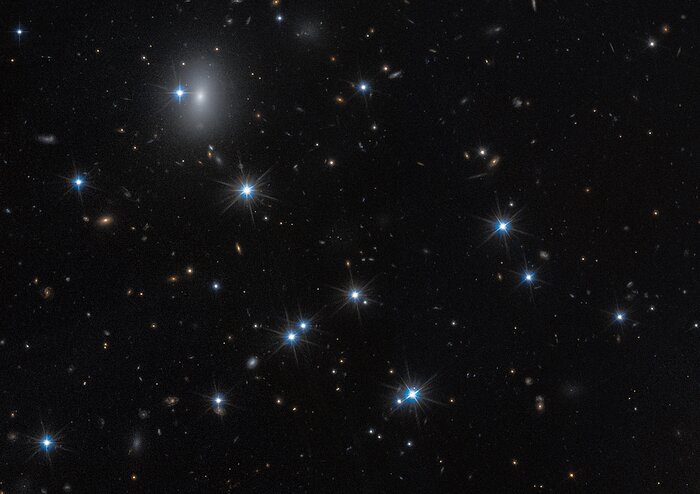
These four dwarf galaxies are part of a census of small galaxies in the tumultuous heart of the nearby Perseus galaxy cluster.
The galaxies appear smooth and symmetrical, suggesting that they have not been tidally disrupted by the pull of gravity in the dense cluster environment. Larger galaxies around them, however, are being ripped apart by the gravitational tug of other galaxies.
The images, taken by NASA's Hubble Space Telescope, are evidence that the undisturbed galaxies are enshrouded by a "cushion" of dark matter, which protects them from their rough-and-tumble neighborhood.
Dark matter is an invisible form of matter that accounts for most of the universe's mass. Astronomers have deduced the existence of dark matter by observing its gravitational influence on normal matter, consisting of stars, gas, and dust.
Observations by Hubble's Advanced Camera for Surveys spotted 29 dwarf elliptical galaxies in the Perseus Cluster, located 250 million light-years away and one of the closest galaxy clusters to Earth. Of those galaxies, 17 are new discoveries.
The images were taken in 2005.
About the colours
The image is a composite of separate exposures made by the ACS instrument on the Hubble Space Telescope. Two filters were used to sample broad wavelength ranges. The color results from assigning different hues (colors) to each monochromatic image. In this case, the assigned colors are: Yellow: F814W (I) Blue: F555W (V)
About the data
This image was created from HST data from proposal 10210 : C. Conselice (University of Nottingham, U.K.), S. De Rijcke (University of Ghent, Belgium), and E. Held (Astronomical Observatory of Padua, Italy).
The science team comprises: S. Penny and C. Conselice (University of Nottingham, U.K.), S. De Rijcke (University of Ghent, Belgium), and E. Held (Astronomical Observatory of Padua, Italy).
More from Perseus and nearby
 Galaxy field of low-surface-brightness galaxy CDG-2February 18, 2026
 Dark Galaxy CDG-2 Near Perseus ClusterFebruary 18, 2026
 Rings and thingsAugust 12, 2024
Little Dumbbell Nebula (WFC3 Image)April 23, 2024
NGC 1333April 20, 2023
 One of the GreatsJuly 5, 2021
Spiral Galaxy UGC 2885January 5, 2020
 Champions LeagueNovember 4, 2019