
Solar System
The Changing Faces of Pluto
February 4, 2010 · NASA
This is the most detailed view to date of the entire surface of the dwarf planet Pluto, as constructed from multiple NASA Hubble Space Telescope photographs taken from 2002 to 2003.
Hubble's view isn't sharp enough to see craters or mountains, if they exist on the surface, but Hubble reveals a complex-looking and variegated world with white, dark-orange, and charcoal-black terrain. The overall color is believed to be a result of ultraviolet radiation from the distant Sun breaking up methane that is present on Pluto's surface, leaving behind a dark, molasses-colored, carbon-rich residue.
The center disk (180 degrees) has a mysterious bright spot that is unusually rich in carbon monoxide frost. This region will be photographed in the highest possible detail when NASA's New Horizons probe flies by Pluto in 2015.
The Hubble images are a few pixels wide. But through a technique called dithering, multiple, slightly offset pictures can be combined through computer-image processing to synthesize a higher-resolution view than could be seen in a single exposure. This series of pictures took four years and 20 computers operating continuously and simultaneously to accomplish.
About the colours
The image is a composite of separate exposures made by the ACS/HRC instrument on the Hubble Space Telescope. Two filters were used to sample broad wavelength ranges. The color results from assigning different hues (colors) to each monochromatic image. In this case, the assigned colors are: Blue: F435W (B) Green: F555W (V)
About the data
The image was created from Hubble data from proposals 5330 : A. Stern (Southwest Research Institute), L. Trafton (University of Texas, Austin), and M. Buie (Southwest Research Institute); and 9391 : M. Buie (Southwest Research Institute), W. Grundy (Lowell Observatory), and E. Young, L. Young, and A. Stern (Southwest Research Institute). The science team comprises: M. Buie (Southwest Research Institute), W. Grundy (Lowell Observatory), and E. Young, L. Young, and A. Stern (Southwest Research Institute).
More Hubble images of Pluto
 Hubble's full photomap of PlutoMarch 7, 2022
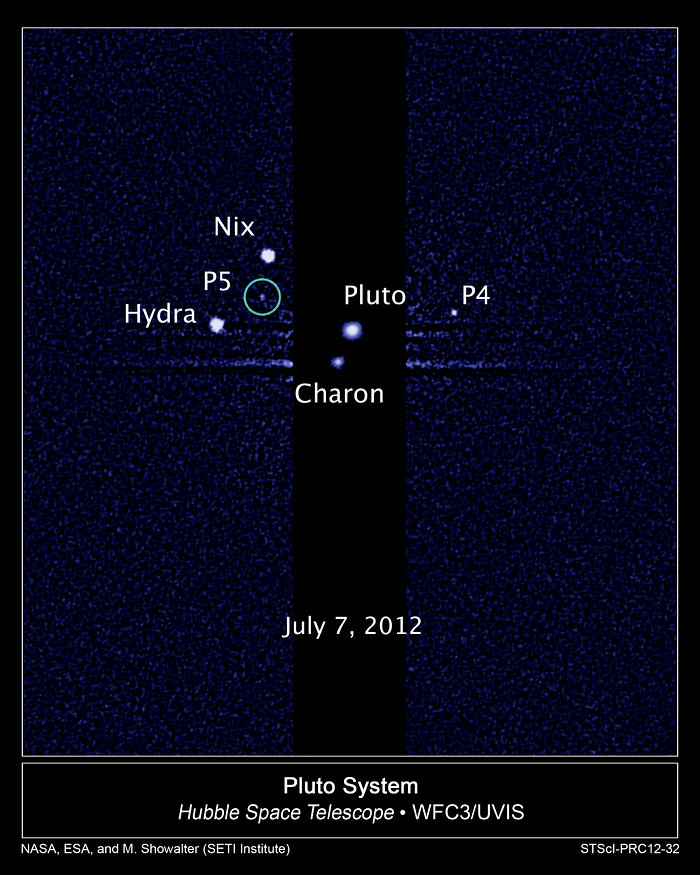 Hubble discovers a fifth moon orbiting PlutoJune 26, 2013
 Pluto’s Moon SystemJuly 20, 2011
Pluto: June 28, 2011 (WFC/UVIS)July 20, 2011
Pluto: July 3, 2011 (WFC/UVIS)July 20, 2011
 Pluto’s Satellite SystemJuly 20, 2011
Pluto – HST – 90° LongitudeFebruary 4, 2010
Pluto – HST – 180° LongitudeFebruary 4, 2010