
Deep fields & lensing
Hubble Helps Astronomers Map Dark Matter in Abell 1689
November 11, 2010 · NASA · Virgo
Zoom to full resolution See where it is in the 3D sky Original on NASA ↗
This NASA Hubble Space Telescope image shows the distribution of dark matter in the center of the giant galaxy cluster Abell 1689, containing about 1,000 galaxies and trillions of stars.
Dark matter is an invisible form of matter that accounts for most of the universe's mass. Hubble cannot see the dark matter directly. Astronomers inferred its location by analyzing the effect of gravitational lensing, where light from galaxies behind Abell 1689 is distorted by intervening matter within the cluster.
Researchers used the observed positions of 135 lensed images of 42 background galaxies to calculate the location and amount of dark matter in the cluster. They superimposed a map of these inferred dark matter concentrations, tinted blue, on an image of the cluster taken by Hubble's Advanced Camera for Surveys. If the cluster's gravity came only from the visible galaxies, the lensing distortions would be much weaker. The map reveals that the densest concentration of dark matter is in the cluster's core.
Abell 1689 resides 2.2 billion light-years from Earth. The image was taken in June 2002.
About the colours
This image is a composite of separate exposures acquired by the ACS instrument on the Hubble Space Telescope (HST). Several filters were used to sample broad wavelength ranges. The color results from assigning different hues (colors) to each monochromatic (grayscale) image associated with an individual filter. In this case, the assigned colors are: Cyan: Dark Matter MapBlue: F475W (g)Green: F625W (r)Red: F775W (i) + F850LP (z)
About the data
ACS/WFC data of Abell 1689 were observed with the HST proposal 9289 : H. Ford and N. Benitez (Johns Hopkins University), and T. Broadhurst (Tel Aviv University).
The science team includes: D. Coe (NASA JPL/Caltech and STScI), N. Benitez (Institute of Astrophysics of Andalusia, Spain), T. Broadhurst (University of the Basque Country, Spain), and H. Ford (Johns Hopkins University).
More Hubble images of Abell 1689
 Hubble Looks Through Cosmic Zoom LensMarch 7, 2022
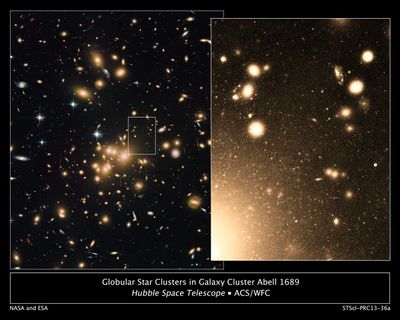 Globular Star Clusters in Galaxy Cluster Abell 1689September 12, 2013
Hubble Wide-Field Image of Galaxy Cluster and Gravitational Lens Abell 1689September 12, 2013
Galaxy Cluster Abell 1689September 12, 2013
Globular Clusters in Abell 1689September 12, 2013
Dark Matter Map in Galaxy Cluster Abell 1689August 19, 2010
Abell 1689 Hubble ACS/WFCAugust 19, 2010
Galaxy Cluster Abell 1689February 12, 2008