
More
Hubble Pinpoints Source of Mysterious Outbursts
April 7, 2011 · NASA · GRB 110328A · Draco
Zoom to full resolution See where it is in the 3D sky Original on NASA ↗
NASA's Hubble Space Telescope has pinpointed the source of one of the most puzzling blasts of high-energy radiation ever observed. It is at the very center of a small, distant galaxy, which appears to be sending a beam of radiation directly toward Earth.
The 3.8-billion-light-year-distant galaxy appears as a bright blob at the center of the Hubble picture.
This observation may support the idea that a supermassive black hole at the core of the galaxy has gravitationally torn apart and swallowed a bypassing star. As the star's gas falls onto the black hole, radiation is ejected along a narrow beam.
On March 28, 2011, NASA's Swift satellite, which looks for transient X-rays and gamma rays, detected the first of a string of powerful bursts of high-energy radiation that has lasted for a week.
More Hubble observations are planned to see if the core changes brightness. An armada of ground- and space-based telescopes is also watching the object from X-ray through radio wavelengths. The Hubble observations were taken in visible and near-infrared light on April 4, 2011, with the Wide Field Camera 3. This Hubble image was taken in visible light.
About the colours
This image is a composite of separate exposures acquired by the WFC3/UVIS instrument on HST. A single filter (F606W) was used to sample a broad wavelength range. Color has been applied to represent brightness, mapping data values into a range of hues from black through red, orange and yellow, to white.
About the data
The image was created from Hubble data from proposal 12447 : A. Fruchter (STScI), J. Bloom and S. Cenko (University of California, Berkeley), J. Graham (Johns Hopkins University), A. Levan (University of Warwick, UK), K. Misra (STScI), D. Perley (California Institute of Technology), and N. Tanvir and K. Wiersema (University of Leicester, UK).
More Hubble images of GRB 110328A
Hubble WFC3 View of GRB 110328A’s Host GalaxyApril 7, 2011
 Swift Images of GRB 110328AApril 7, 2011
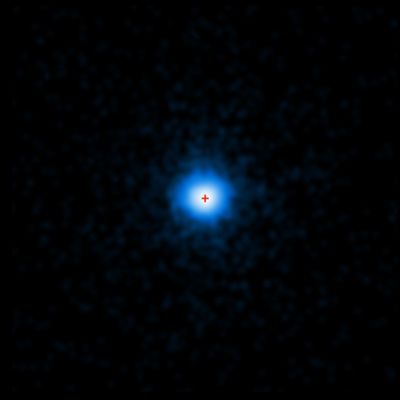 Chandra Image of GRB 110328AApril 7, 2011
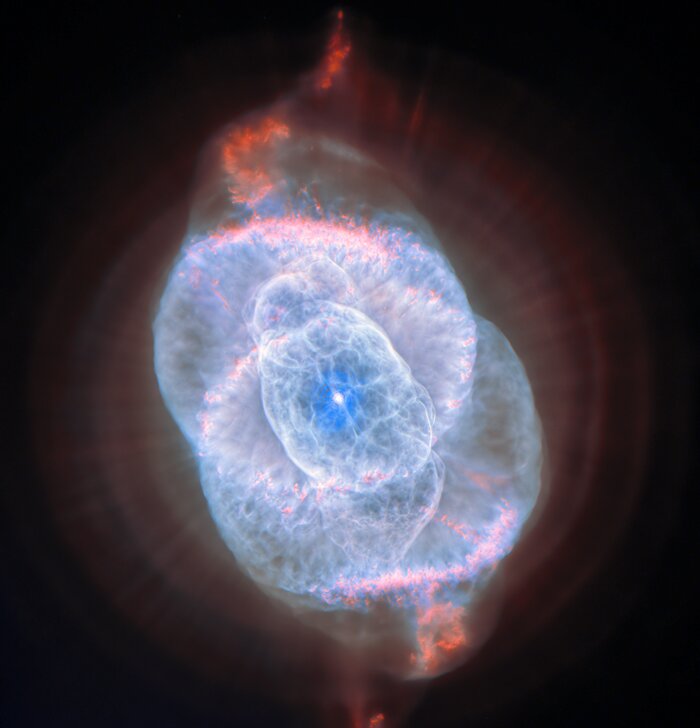 Looking at the Cat’s Eye Nebula with HubbleMarch 3, 2026
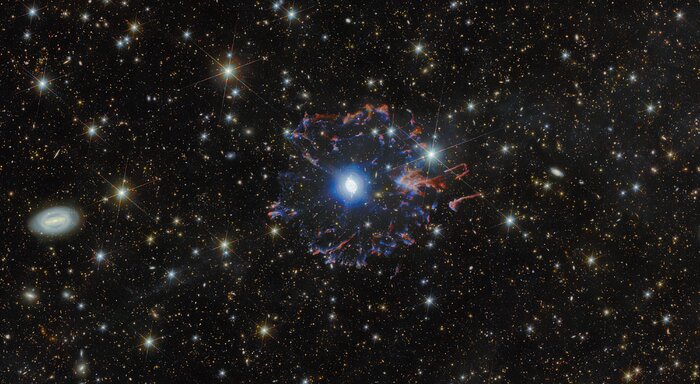 Euclid and Hubble's view of Cat's Eye NebulaMarch 3, 2026
Draco Dwarf SpheroidalJuly 11, 2024
 Cosmic leviathanMay 8, 2023
 Lonely SpiralDecember 27, 2021