
Deep fields & lensing
Lensing Galaxy Cluster Abell 383
April 12, 2011 · NASA · Eridanus
Zoom to full resolution See where it is in the 3D sky Original on NASA ↗
Astronomers have uncovered one of the youngest galaxies in the distant universe, with stars that formed 13.5 billion years ago, a mere 200 million years after the Big Bang. The finding addresses questions about when the first galaxies arose, and how the early universe evolved.
NASA's Hubble Space Telescope was the first to spot the newfound galaxy. Detailed observations from the W.M. Keck Observatory on Mauna Kea in Hawaii revealed the observed light dates to when the universe was only 950 million years old; the universe formed about 13.7 billion years ago.
Infrared data from both Hubble and NASA's Spitzer Space Telescope revealed the galaxy's stars are quite mature, having formed when the universe was just a toddler at 200 million years old.
The galaxy's image is being magnified by the gravity of a massive cluster of galaxies (Abell 383) parked in front of it, making it appear 11 times brighter. This phenomenon is called gravitational lensing.
Hubble imaged the lensing galaxy Abell 383 with the Wide Field Camera 3 and the Advanced Camera for Surveys in November 2010 through March 2011.
About the data
The image was created from Hubble data from proposal 12065 : M. Postman (PI; STScI) et al.
The science team comprises: J. Richard (Centre for Astronomical Research/Observatory of Lyon, France), J.-P. Kneib (Astrophysical Laboratory of Marseille, France), H. Ebeling (Institute of Astronomy/University of Hawaii), D. Stark (Institute of Astronomy/University of Cambridge, UK), and E. Egami and A. Fiedler (Steward Observatory/University of Arizona)
More Hubble images of Abell 383
Galaxy Cluster Abell 383May 1, 2014
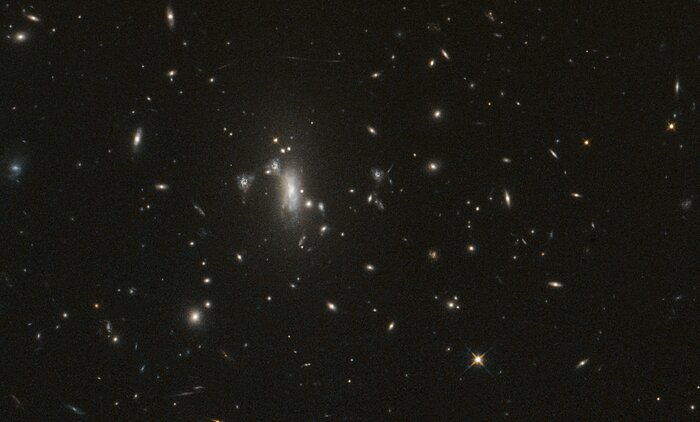 Hubble seeks lensed supernova, marks 200,000 orbitsSeptember 30, 2026
 SN 2025pht in NGC 1637February 23, 2026
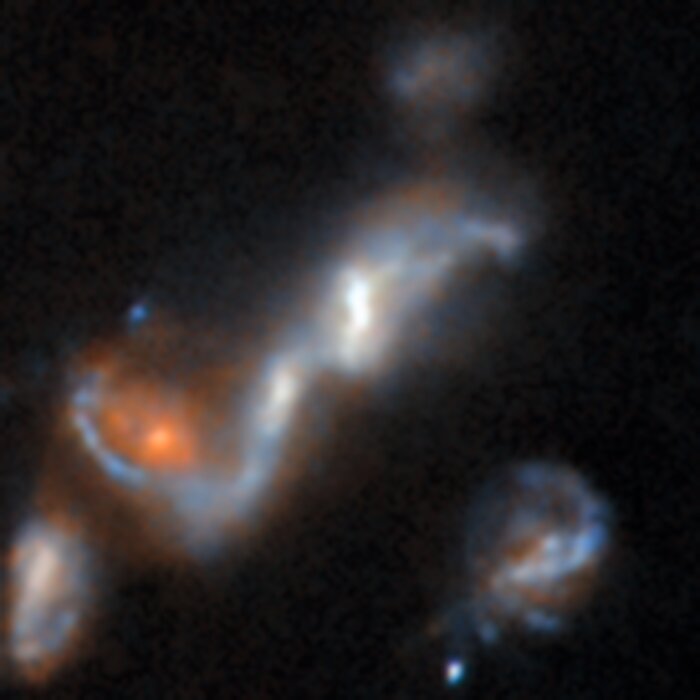 An anomaly from Hubble’s archive — Merging galaxies 2January 27, 2026
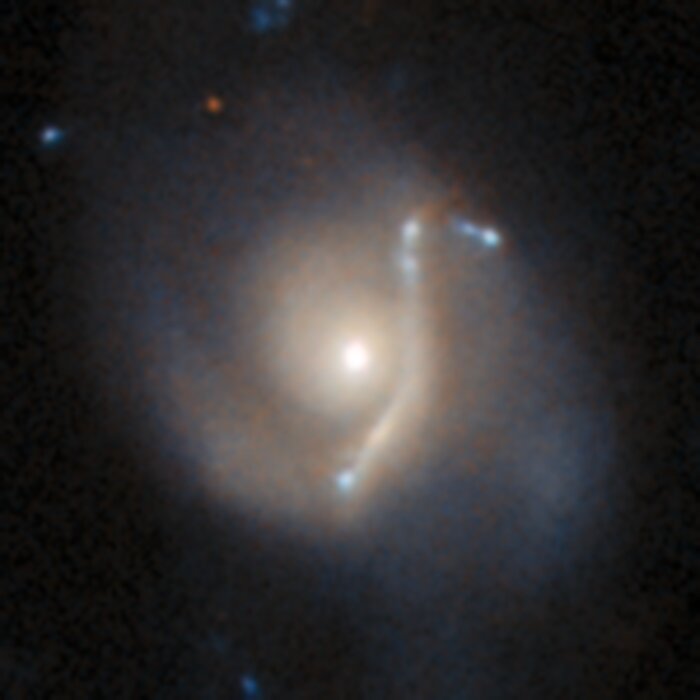 An anomaly from Hubble’s archive — Gravitational lens 1January 27, 2026
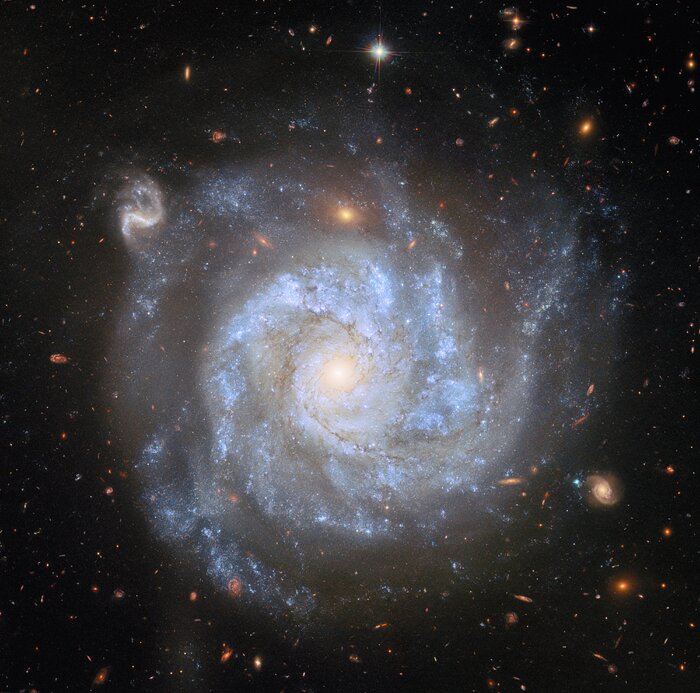 A supernova-rich spiralJuly 28, 2025
 Starry spectacleJune 2, 2025
 Signs of the stellar lifecycleDecember 2, 2024