
Deep fields & lensing
Hubble Sees Giant Lensed Galaxy Arc
February 2, 2012 · NASA · RCS2 032727-132623, RCSGA 032727-132609 · Eridanus
Zoom to full resolution See where it is in the 3D sky Original on NASA ↗
Thanks to the presence of a natural "zoom lens" in space, this is a close-up look at the brightest distant "magnified" galaxy in the universe known to date. It is one of the most striking examples of gravitational lensing, where the gravitational field of a foreground galaxy bends and amplifies the light of a more distant background galaxy. In this image the light from a distant galaxy, nearly 10 billion light-years away, has been warped into a nearly 90-degree arc of light in the galaxy cluster RCS2 032727-132623. The galaxy cluster lies 5 billion light-years away. The background galaxy's image is over three times brighter than typically lensed galaxies. The natural-color image was taken in March 2011 with the Hubble Space Telescope's Wide Field Camera 3.
About the colours
This image is a composite of separate exposures acquired by the WFC3 instrument on HST. Several filters were used to sample broad wavelength ranges. The color results from assigning different hues (colors) to each monochromatic (grayscale) image associated with an individual filter. In this case, the assigned colors are: Blue: F390W (U) + F606W (V) Green: F814W (I) Red: F098M (blue grism) + F125W (J) + F132N (Paschen β) + F160W (H)
About the data
The image was created from Hubble data from proposal 12267 : J. Rigby (NASA Goddard Space Flight Center) et al.
More Hubble images of RCS2 032727-132623, RCSGA 032727-132609
 Hubble sees giant lensed galaxy arcFebruary 8, 2012
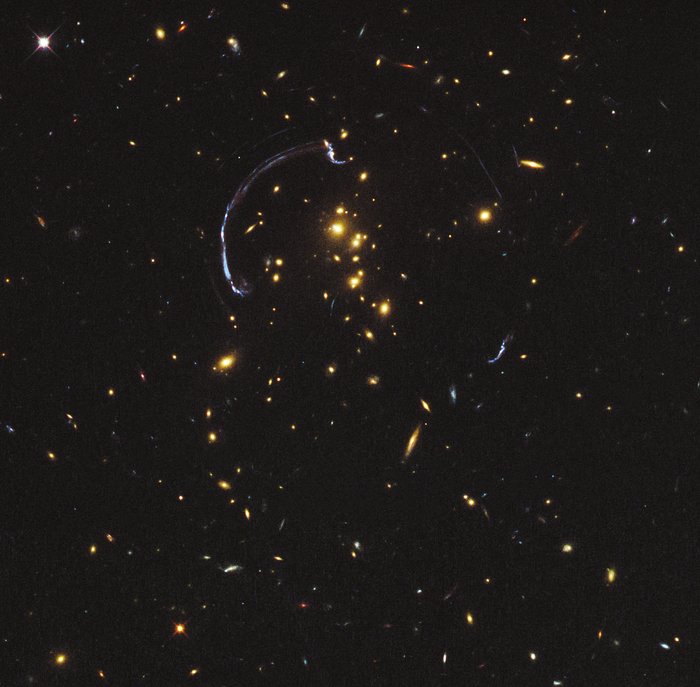 Galaxy cluster RCS2 032727-132623 (uncropped)February 8, 2012
 The core of RCS2 032727-132623 and reconstruction of RCSGA 032727-132609February 8, 2012
Hubble Image of Galaxy Cluster RCS2 032727-132623 (Uncropped)February 2, 2012
 Hubble WFC3 Image of Core of RCS2 032727-132623 and Reconstruction of RCSGA 032727-132609February 2, 2012
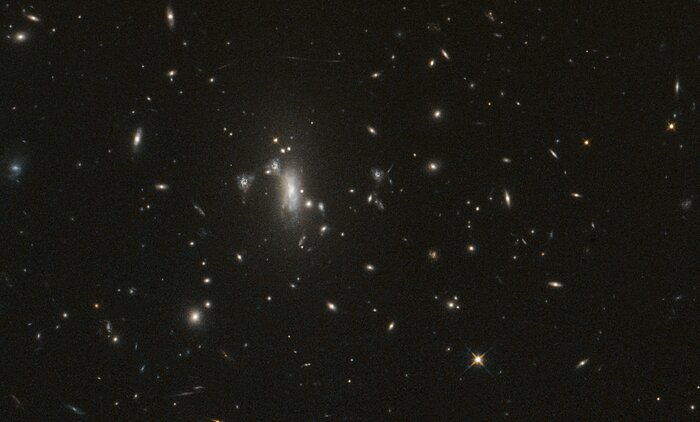 Hubble seeks lensed supernova, marks 200,000 orbitsSeptember 30, 2026
 SN 2025pht in NGC 1637February 23, 2026
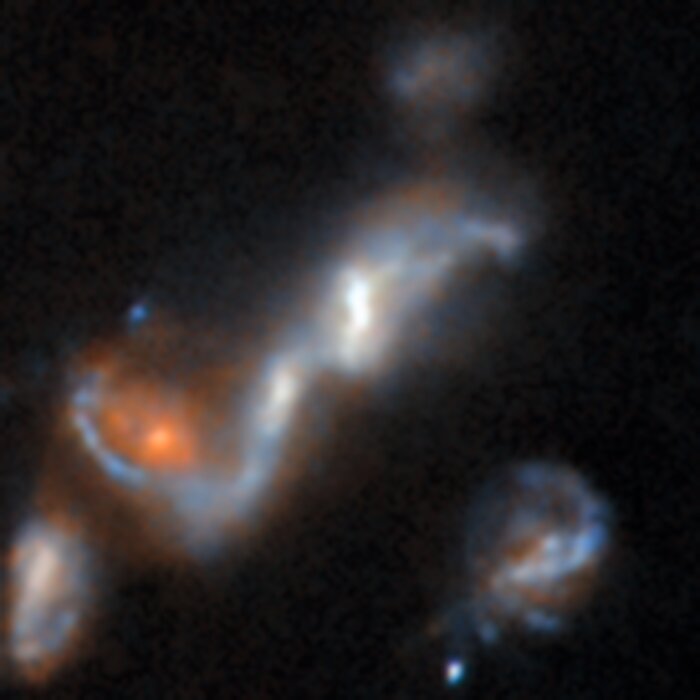 An anomaly from Hubble’s archive — Merging galaxies 2January 27, 2026