
Deep fields & lensing
Merging Galaxy Cluster Abell 520
March 2, 2012 · NASA · Orion
Zoom to full resolution See where it is in the 3D sky Original on NASA ↗
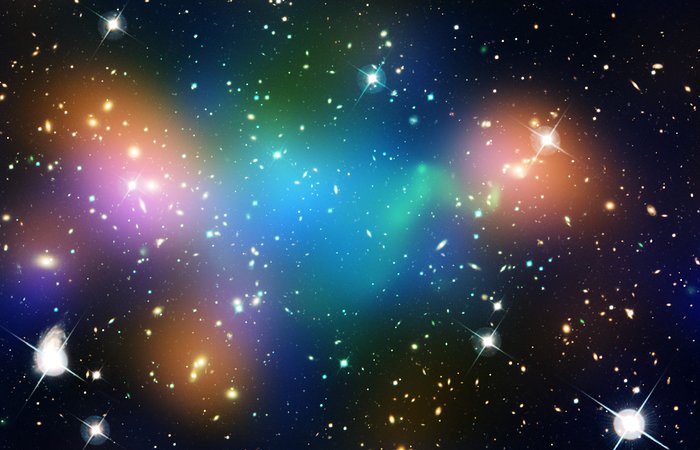
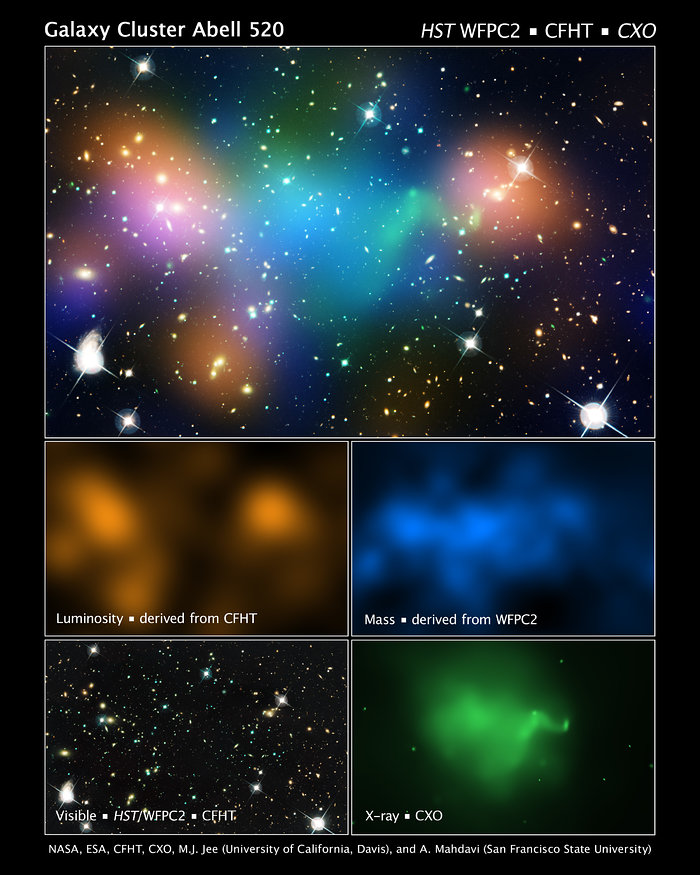
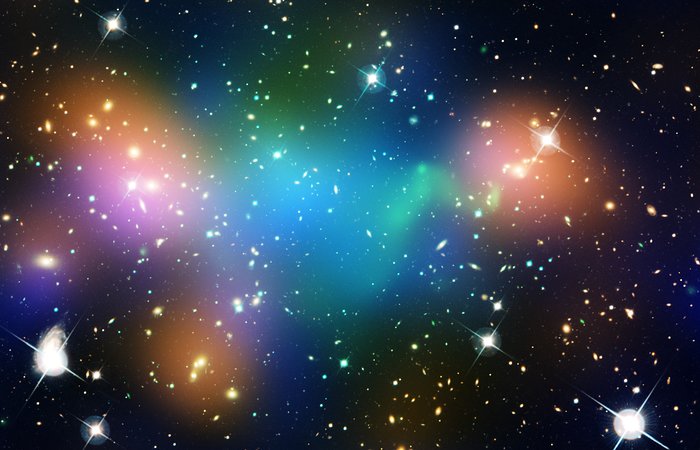
This composite image shows the distribution of dark matter, galaxies, and hot gas in the core of the merging galaxy cluster Abell 520, formed from a violent collision of massive galaxy clusters.
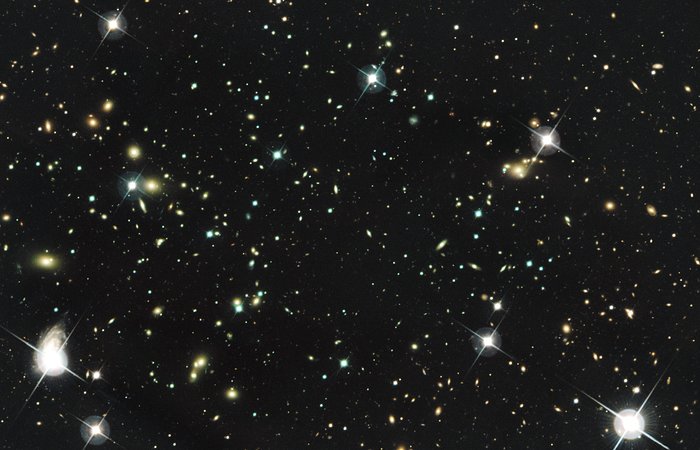
The natural-color image of the galaxies was taken with NASA's Hubble Space Telescope and with the Canada-France-Hawaii Telescope in Hawaii.
Superimposed on the image are "false-colored" maps showing the concentration of starlight, hot gas, and dark matter in the cluster. Starlight from galaxies, derived from observations by the Canada-France-Hawaii Telescope, is colored orange. The green-tinted regions show hot gas, as detected by NASA's Chandra X-ray Observatory. The gas is evidence that a collision took place. The blue-colored areas pinpoint the location of most of the mass in the cluster, which is dominated by dark matter. Dark matter is an invisible substance that makes up most of the universe's mass. The dark-matter map was derived from the Hubble Wide Field Planetary Camera 2 observations by detecting how light from distant objects is distorted by the cluster of galaxies, an effect called gravitational lensing.
The blend of blue and green in the center of the image reveals that a clump of dark matter resides near most of the hot gas, where very few galaxies are found. This finding confirms previous observations of a dark-matter core in the cluster. The result could present a challenge to basic theories of dark matter, which predict that galaxies should be anchored to dark matter, even during the shock of a collision.
Abell 520 resides 2.4 billion light-years away.
About the colours
This image is a composite of separate exposures acquired by the HST/WFPC2 instrument, the Canada-France-Hawaii Telescope (CFHT), and the Chandra X-ray Observatory. Several filters were used to sample various wavelength and energy ranges. The color results from assigning different hues (colors) to each monochromatic (grayscale) image associated with an individual filter. In this case, the assigned colors are: White (visible): CFHT (B) + CFHT (V) + HST/WFPC2 F814W (I) Red (luminosity): CFHT Blue: HST/WFPC2 F814W (I) Green: CXO X-ray
About the data
The image was created from Hubble data from proposal 11221 : J. Dalcanton (University of Washington, Seattle), A. Mahdavi (San Francisco State University), H. Hoekstra (Leiden Observatory), and A. Babul (University of Victoria, BC). The science paper is led by M.J. Jee (University of California, Davis).
More Hubble images of Abell 520
Mapping the dark matter in the core of galaxy cluster Abell 520November 30, 2012
 Merging galaxy cluster Abell 520March 23, 2012
 Galaxy cluster Abell 520 (plus CFHT, HST, CFHT/HST, and CXO overlays)March 23, 2012
 Galaxy custer Abell 520 (HST-CFHT-CXO composite)March 23, 2012
 Galaxy cluster Abell 520 (CFHT and HST)March 23, 2012
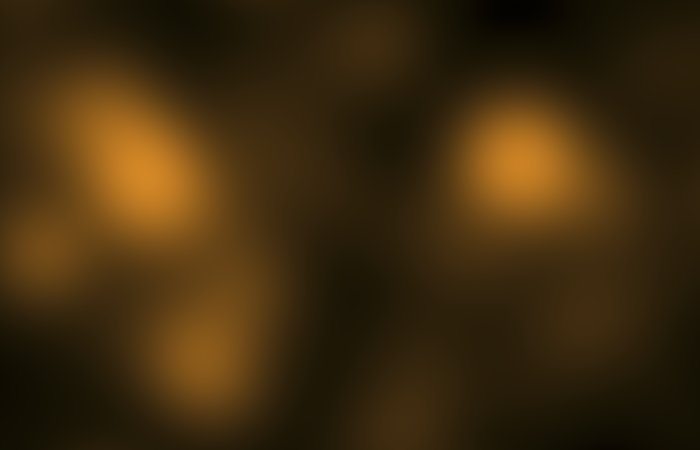 Galaxy cluster Abell 520's luminosity (CFHT)March 23, 2012
 Galaxy cluster Abell 520's hot gas (Chandra)March 23, 2012
 Galaxy cluster Abell 520's mass (HST WFPC2)March 23, 2012