
Galaxies
Halo of Andromeda Galaxy Used to Measure Its Drift Across Space
May 31, 2012 · NASA · M31, NGC 224, Andromeda Galaxy · Andromeda
Zoom to full resolution See where it is in the 3D sky Original on NASA ↗
This composite image shows a region in the halo in the neighboring Andromeda galaxy that astronomers used to precisely measure the galaxy's sideways motion on the sky. This has allowed them to predict a direct collision between Andromeda and the Milky Way about 4 billion years from now.
The inset image on the left is from a 2002 Hubble Space Telescope deep exposure that captured the light from 300,000 stars in Andromeda's halo, a vast spherical cloud of stars surrounding the galaxy's bright disk. Embedded in the image are numerous background galaxies that are much father away than Andromeda.
Astronomers compared this region to pictures of the same area taken seven years later. They measured the tiny amount of sideways drift in the halo stars relative to the stationary background galaxy field. The same measurements were done for two other fields in the galaxy as well. This is similar to measuring the drift of a boat relative to a background shoreline.
About the colours
This image is a composite of separate exposures acquired by the ACS instrument on HST. Several filters were used to sample broad wavelength ranges. The color results from assigning different hues (colors) to each monochromatic (grayscale) image associated with an individual filter. In this case, the assigned colors are: Blue: F606W (V) Red: F814W (I)
About the data
The Hubble data were taken from the HST proposals 9453 and 10265 , PI: T. Brown (STScI); and 11684 , PI: R. van der Marel (STScI).
The science team comprises: R. van der Marel, S.T. Sohn, J. Anderson, and T. Brown (STScI), M. Fardal (University of Massachusetts, Amherst), G. Besla (Columbia University), R. Beaton (University of Virginia), P. Guhathakurta (UCO/Lick Observatory/UCSC), and T.J. Cox (Carnegie Observatories).
More Hubble images of M31, NGC 224, Andromeda Galaxy
Crash of the Titans: Andromeda Galaxy and the Milky Way CollisionMay 31, 2012
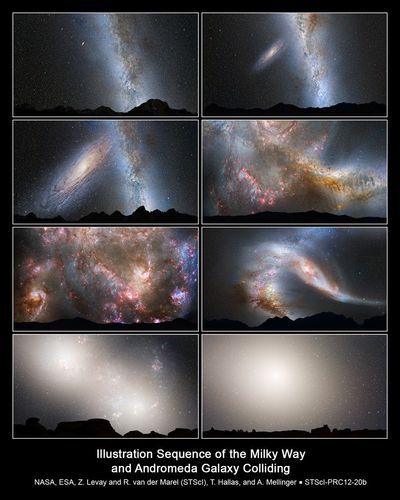 Nighttime Sky View of Future Galaxy MergerMay 31, 2012
Nighttime Sky View of Future Galaxy Merger: Present DayMay 31, 2012
Nighttime Sky View of Future Galaxy Merger: 2 Billion YearsMay 31, 2012
Nighttime Sky View of Future Galaxy Merger: 3.75 Billion YearsMay 31, 2012
Nighttime Sky View of Future Galaxy Merger: 3.85-3.9 Billion YearsMay 31, 2012
Nighttime Sky View of Future Galaxy Merger: 3.85-3.9 Billion YearsMay 31, 2012
Nighttime Sky View of Future Galaxy Merger: 4 Billion YearsMay 31, 2012