
Solar System
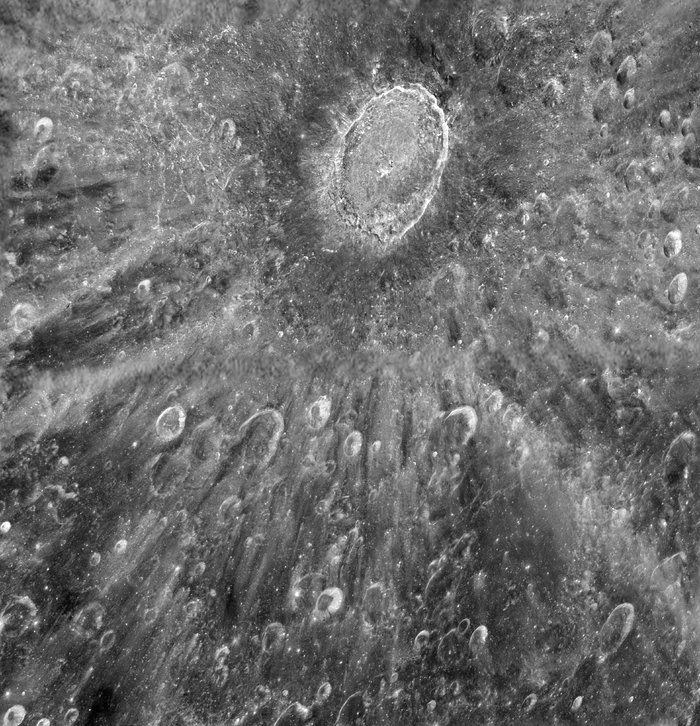
Crater Tycho on the Moon
May 4, 2012 · NASA · Moon, Tycho
This mottled landscape showing the impact crater Tycho is among the most violent-looking places on our Moon.
This image, taken with Hubble's Advanced Camera for Surveys, reveals lunar features as small as roughly 560 feet (170 meters) across. The large "bulls-eye" near the top of the picture is the impact crater, caused by an asteroid strike about 100 million years ago. The bright trails radiating from the crater were formed by material ejected from the impact area during the asteroid collision. Tycho is about 50 miles (80 kilometers) wide and is circled by a rim of material rising almost 3 miles (5 kilometers) above the crater floor. The image measures 430 miles (700 kilometers) across, which is slightly larger than New Mexico.
About the colours
This is a black and white (grayscale) image from a single exposure acquired by the ACS instrument on HST. Gaps in the HST data have been filled using an image at similar lunar phase from the Consolidated Lunar Atlas.
About the data
The image was created from Hubble data from proposal 12537 : D. Ehrenreich (Institut de Planétologie et d’Astrophysique de Grenoble (IPAG)/CNRS/Université Joseph Fourier), L. Arnold (CNRS, Laboratoire d'Astrophysique de Marseille), A. Vidal-Madjar (CNRS, Institut d'Astrophysique de Paris), M. Barthelemy (Université de Grenoble I), I. Boisse (CNRS, Institut d'Astrophysique de Paris), F. Bouchy (CNRS, Institut d'Astrophysique de Paris), R. Cabanac (Observatoire Midi-Pyrénées), J.-M. Desert (Harvard University), R. Ferlet (CNRS, Institut d'Astrophysique de Paris), G. Gronoff (NASA Langley Research Center), G. Hebrard (CNRS, Institut d'Astrophysique de Paris), A. Lecavelier des Etangs (CNRS, Institut d'Astrophysique de Paris), J. Lilensten (Institut de Planétologie et d'Astrophysique de Grenoble), J. McConnell (York University), C. Moutou (CNRS, Laboratoire d'Astrophysique de Marseille), C. Nitschelm (Universidad Catolica del Norte), D. Kent Sing (University of Exeter).
The primary objective of the program was spectroscopic observations with STIS to analyze sunlight reflected from the Moon. Images were obtained in parallel with ACS.
More solar system
 Hubble Discovers a Fifth Moon Orbiting PlutoJuly 11, 2012
Motion of Pluto’s Five MoonsJuly 11, 2012 · video
 Hubblecast 56: Dramatic change spotted on a faraway planetJune 28, 2012 · video
 Using the Moon as a mirror — Hubble to watch transit of Venus in reflected lightMay 7, 2012
Hubble Shoots The Moon During Venus TransitMay 4, 2012
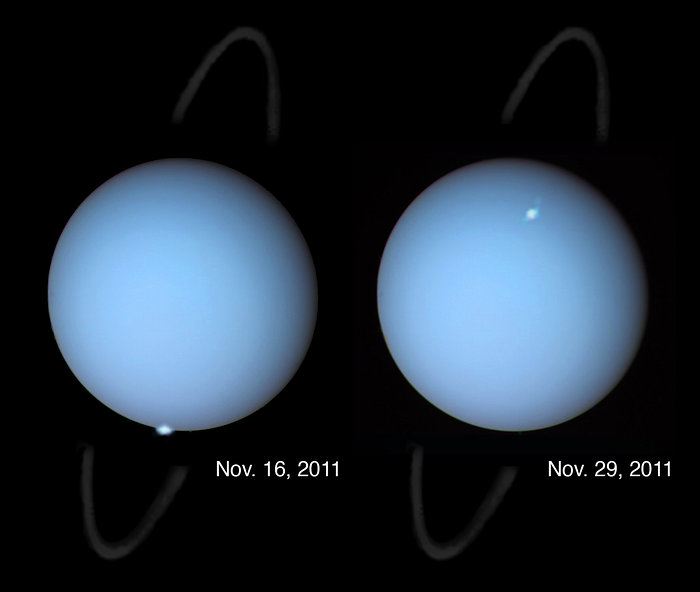 Hubble spots aurorae on the planet UranusApril 23, 2012
 Hubble Spots Aurorae on the Planet UranusApril 19, 2012
 Hypothetical Near Pass of AsteroidJanuary 16, 2012 · video