
Deep fields & lensing
Monster Galaxy Lacks a Bright Core
October 25, 2012 · NASA · Abell 2261, A2261-BCG · Hercules
Zoom to full resolution See where it is in the 3D sky Original on NASA ↗
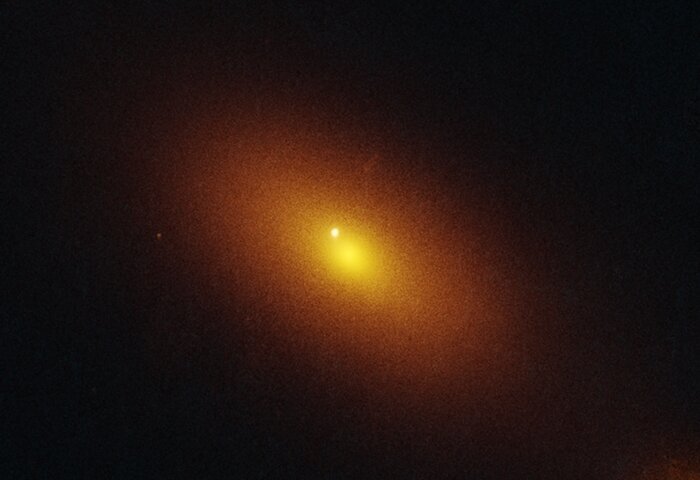
The giant elliptical galaxy in the center of this image, taken by NASA's Hubble Space Telescope, is the most massive and brightest member of the galaxy cluster Abell 2261.
Spanning a little more than one million light-years, the galaxy is about 10 times the diameter of our Milky Way galaxy. The bloated galaxy is a member of an unusual class of galaxies with a diffuse core filled with a fog of starlight. Normally, astronomers would expect to see a concentrated peak of light around a central black hole. The Hubble observations revealed that the galaxy's puffy core, measuring about 10,000 light-years, is the largest yet seen.
The observations present a mystery, and studies of this galaxy may provide insight into how black hole behavior may shape the cores of galaxies.
Astronomers used Hubble's Advanced Camera for Surveys and Wide Field Camera 3 to measure the amount of starlight across the galaxy, dubbed A2261-BCG. Abell 2261 is located three billion light-years away.
The observations were taken March to May 2011. The Abell 2261 cluster is part of a multi-wavelength survey called the Cluster Lensing And Supernova survey with Hubble (CLASH).
About the colours
This image is a composite of separate exposures acquired by the ACS instrument. Several filters were used to sample various wavelengths. The color results from assigning different hues (colors) to each monochromatic (grayscale) image associated with an individual filter. In this case, the assigned colors are: Blue: ACS/WFC F435W (B) + F475W (g) Green: ACS/WFC F606W (V) + F625W (r) + F775W (i) Red: ACS/WFC F814W (I) + F850LP (z), WFC3/IR F105W (Y) + F110W (YJ) + F125W (J) + F140W (JH) + F160W (H)
About the data
The image was created from Hubble data from proposal 12066 : M. Postman (STScI) et al.
More from Hercules and nearby
NGC 6099 (Hubble + Chandra)July 24, 2025
NGC 6099 (Hubble)July 24, 2025
 Hubble observes new tidal disruption event (January 2025 image)May 8, 2025
Black Hole TDE AT2024tvdMay 8, 2025
Black Hole TDE AT2024tvd (Hubble + Chandra)May 8, 2025
 Dim, but still distinctJanuary 29, 2024
 When one plus one (eventually) equals oneJanuary 8, 2024
 Follow the LEDAJuly 25, 2022