
Deep fields & lensing
Cluster MACS J0647 Provides Three Magnified Views of Distant Galaxy
November 15, 2012 · NASA · MACS J0647+7015, MACS0647-JD · Camelopardalis
Zoom to full resolution See where it is in the 3D sky Original on NASA ↗
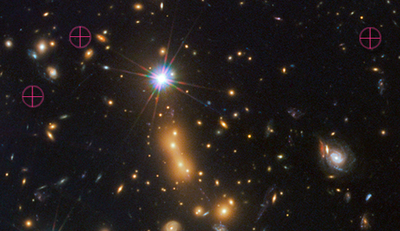
In this image, astronomers use NASA's Hubble Space Telescope and a cosmic zoom lens to uncover the farthest known galaxy in the universe.
The newly discovered galaxy, named MACS0647-JD, is very young and only a tiny fraction of the size of our Milky Way. The object is observed 420 million years after the big bang, when the universe was 3 percent of its present age of 13.7 billion years.
Astronomers used the powerful gravity from the massive galaxy cluster MACS J0647+7015 to magnify the light from the distant galaxy, an effect called gravitational lensing. The bright yellow galaxies near the center of the image are cluster members.
Due to the gravitational lensing technique, astronomers observed three magnified images of MACS0647-JD with the Hubble telescope. The cluster's gravity boosted the light from the faraway galaxy, making the images appear approximately eight, seven, and two times brighter than they otherwise would, enabling astronomers to detect the galaxy more efficiently and with greater confidence. Without the cluster's magnification powers, astronomers would not have seen this remote galaxy. The three close-up images of the magnified galaxy appear in the insets at left.
This is the latest discovery from a large program, called the Cluster Lensing And Supernova survey with Hubble (CLASH), that uses natural zoom lenses to reveal distant galaxies in the early universe.
This image is a composite taken with Hubble's Wide Field Camera 3 and the Advanced Camera for Surveys. The observations were taken Oct. 5 and Nov. 29, 2011.
About the colours
This image is a composite of separate exposures acquired by the ACS and WFC3 instruments. Several filters were used to sample various wavelengths. The color results from assigning different hues (colors) to each monochromatic (grayscale) image associated with an individual filter. In this case, the assigned colors are: Blue: ACS/WFC F435W (B) + F475W (g) + F555W (V) + F606W (V) + F625W (r) Green: ACS/WFC F775W (I) + F814W (I) + F850LP (z), and WFC3/IR F105W (Y) + F110W (YJ) + F125W (J) Red: WFC3/IR F140W (JH) + F160W (H)
About the data
The image was created from Hubble data from proposals 12101 : M. Postman (STScI); 9722 : H. Ebeling (University of Hawaii); and 10493 and 10793 : A. Gal-Yam (Weizmann Institute of Science, Israel).
More Hubble images of MACS J0647+7015, MACS0647-JD
 Distant Galaxy Lensed by Cluster MACS J0647November 15, 2012
 Snapshot of a peculiar spiralApril 28, 2025
 Hiding a bright secretAugust 26, 2024
 Aftermath of a cosmic explosionApril 3, 2023
 Big, Beautiful and BlueMarch 1, 2021
 Stuck in the middleApril 23, 2018
 Hubble’s Hidden GalaxyJuly 3, 2017
 Einstein revisitedJune 12, 2017