
Black holes
Very Distant Quasar May Be Embedded in Unusually Dusty Galaxy (Hubble View)
October 22, 2012 · NASA
This is a NASA Hubble Space Telescope view of one of the most distant and luminous quasars ever seen. Quasars (short for quasi-stellar object) are the brilliant cores of galaxies where infalling material fuels a supermassive black hole.
The quasar dates back to an early time in the universe's history-less than one billion years after the big bang and is seen as it was about 12.8 billion years ago. It is suspected that the quasar contains large amounts of dust that are believed to be hiding the view of the underlying galaxy of stars in which the quasar is presumably embedded.
This near-infrared light image was taken with Hubble's Wide Field Camera 3 in Dec. 2010 and Jan. 2011. The circle indicates the quasar, which appears much brighter than many of the galaxies in the foreground, which are typically seen when the universe had already attained half of its current age of 13.7 billion years.
More black holes
Hubble Optical Image of Hercules A (3C 348)November 29, 2012
VLA Radio Image of Hercules A (3C 348)November 29, 2012
A 3-D Perspective on Hercules ANovember 29, 2012 · video
Hercules A Zoom SequenceNovember 29, 2012 · video
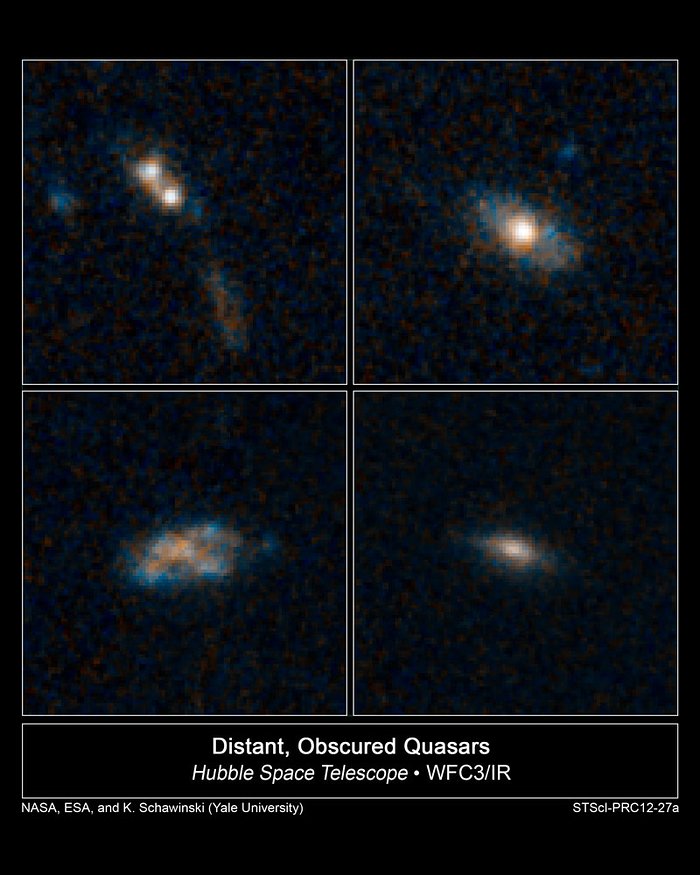 The homes of quasarsJune 27, 2012
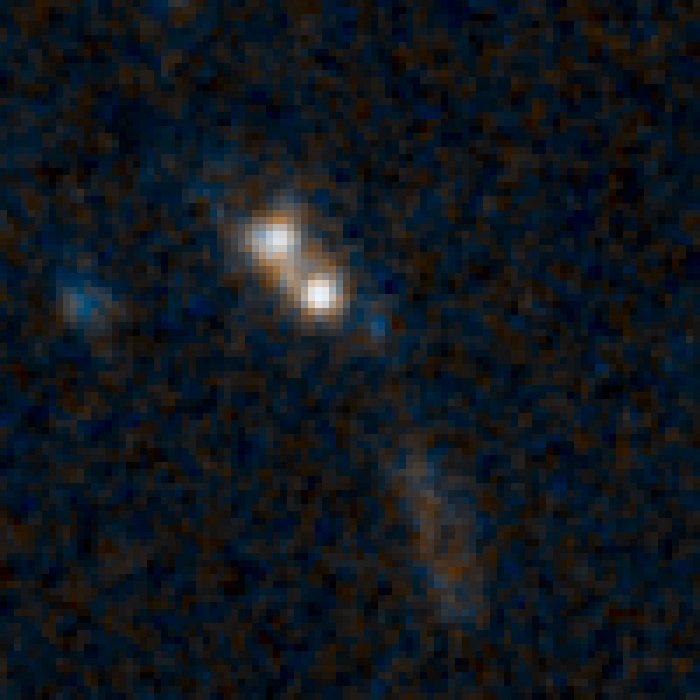 Sample galaxy 29263June 27, 2012
 Sample galaxy 25783June 27, 2012
 Sample galaxy 33160June 27, 2012