
Deep fields & lensing
Gamma-ray Burst 130603B
August 3, 2013 · NASA · GRB 130603B, SDS J112848.22+170418.5 · Leo
Zoom to full resolution See where it is in the 3D sky Original on NASA ↗
These images taken by NASA's Hubble Space Telescope reveal a new type of stellar explosion produced from the merger of two compact objects.
Hubble spotted the outburst while looking at the aftermath of a short- duration gamma-ray burst, a mysterious flash of intense high-energy radiation that appears from random directions in space. Short-duration blasts last at most a few seconds. They sometimes, however, produce faint afterglows in visible and near-infrared light that continue for several hours or days and help astronomers pinpoint the exact location of the burst.
In the image at left, the galaxy in the center produced the gamma-ray burst, designated GRB 130603B. The galaxy, cataloged as SDS J112848.22+170418.5, resides almost 4 billion light-years away. A probe of the galaxy with Hubble's Wide Field Camera 3 on June 13, 2013, revealed a glow in near-infrared light at the source of the gamma-ray burst, shown in the image at top, right. When Hubble observed the same location on July 3, the source had faded, shown in the image at below, right. The fading glow provided key evidence that it was the decaying fireball of a new type of stellar blast called a kilonova.
Kilonovas are about 1,000 times brighter than a nova, which is caused by the eruption of a white dwarf. But they are 1/10th to 1/100th the brightness of a typical supernova, the self-detonation of a massive star.
About the colours
This image is a composite of separate exposures acquired by the ACS/WFC and WFC3/IR instruments. Several filters were used to sample various wavelengths. The color results from assigning different hues (colors) to each monochromatic (grayscale) image associated with an individual filter. In this case, the assigned colors are: Blue/cyan: F606W (V) Orange: F160W (H)
About the data
The image was created from Hubble data from proposal 13497 : N. Tanvir (University of Leicester), J. Hjorth (University of Copenhagen, Niels Bohr Institute), A. Levan (University of Warwick), K. Wiersema (University of Leicester), and A. Fruchter (STScI).
The science team includes: N. Tanvir (University of Leicester), A. Levan (University of Warwick), A. Fruchter (STScI), J. Hjorth (University of Copenhagen, Niels Bohr Institute), R. Hounsell (STScI), K. Wiersema (University of Leicester), and R. Tunnicliffe (University of Warwick).
More Hubble images of GRB 130603B, SDS J112848.22+170418.5
GRB 130603B – June 13, 2013August 3, 2013
GRB 130603B – July 3, 2013August 3, 2013
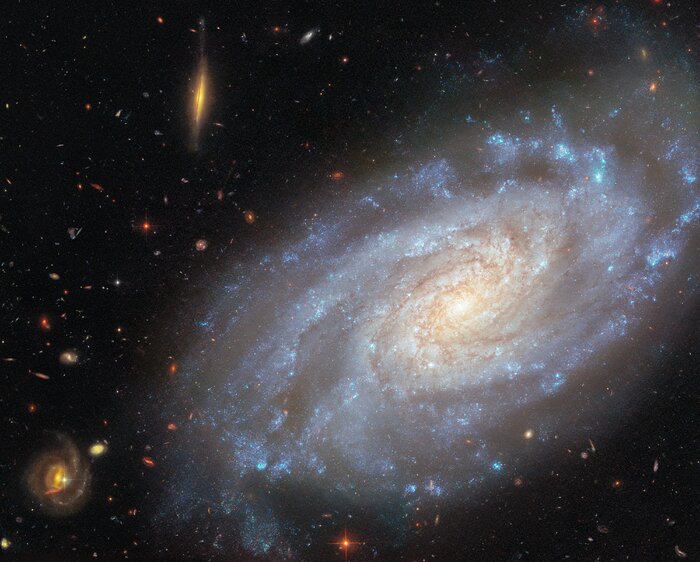 Focusing on NGC 3370October 20, 2025
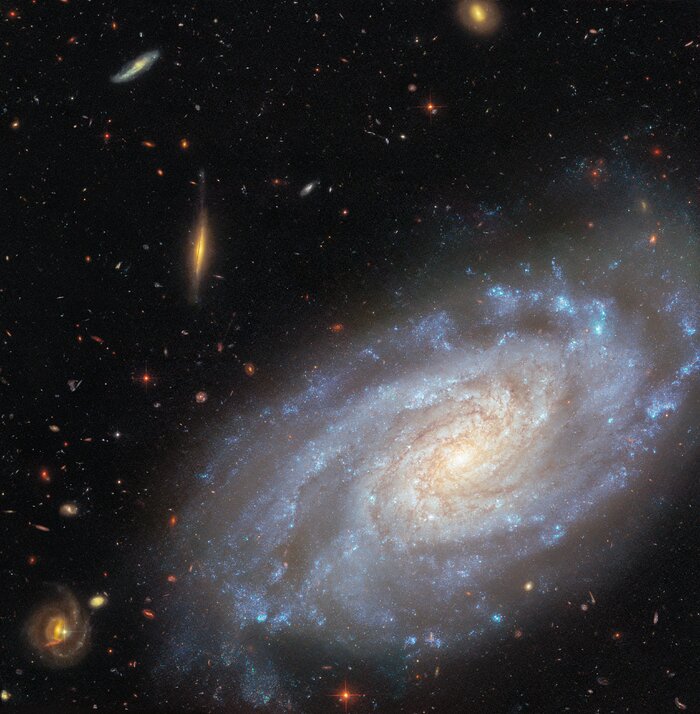 NGC 3370 (wide view)October 20, 2025
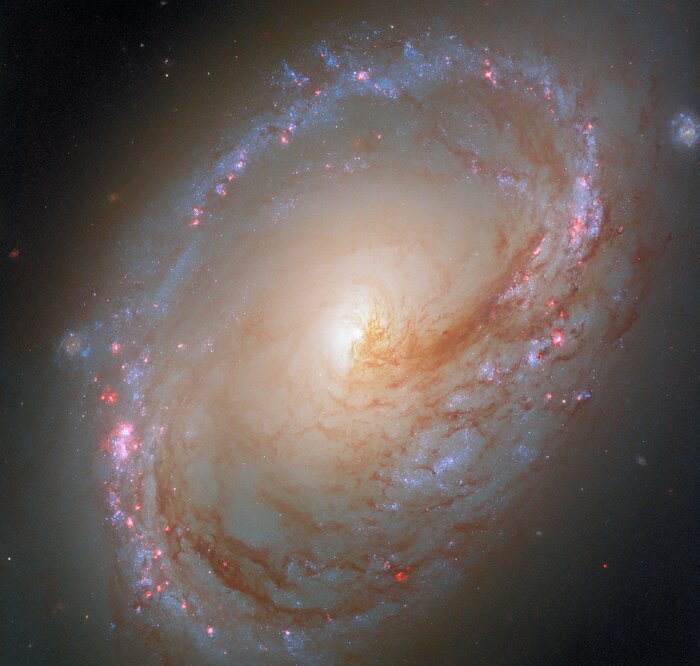 Taking a third lookAugust 25, 2025
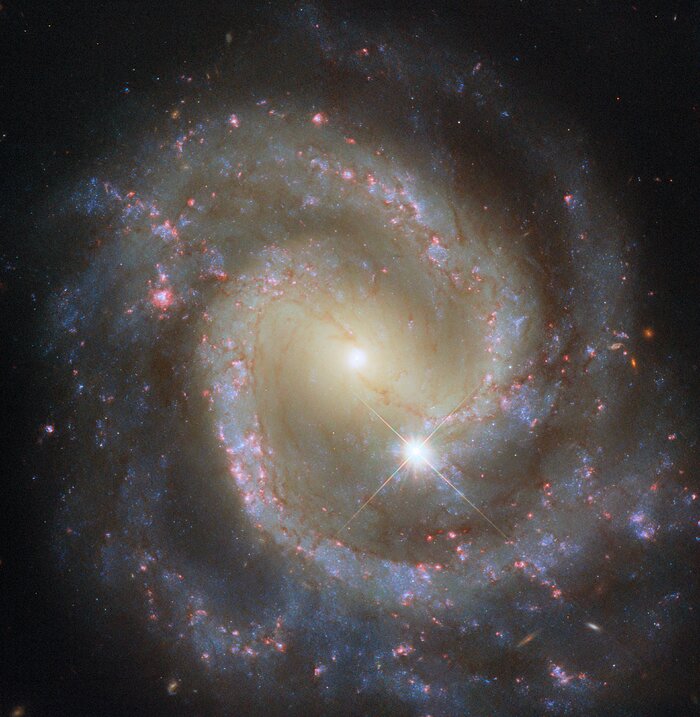 Paired pinwheel seen soloMay 26, 2025
 Face to face with a spiral’s armsMay 5, 2025
 The difference between distance and dustJuly 8, 2024