
Deep fields & lensing
Hubble Frontier Field Abell 2744
January 7, 2014 · NASA · Abell 2744, Pandora's Cluster · Sculptor
Zoom to full resolution See where it is in the 3D sky Original on NASA ↗
This long-exposure Hubble Space Telescope image of massive galaxy cluster Abell 2744 is the deepest ever made of any cluster of galaxies. It shows some of the faintest and youngest galaxies ever detected in space. Abell 2744, located in the constellation Sculptor, appears in the foreground of this image. It contains several hundred galaxies as they looked 3.5 billion years ago. The immense gravity in Abell 2744 acts as a gravitational lens to warp space and brighten and magnify images of nearly 3,000 distant background galaxies. The more distant galaxies appear as they did longer than 12 billion years ago, not long after the big bang. This image is part of an unprecedented long-distance view of the universe from an ambitious collaborative project among the NASA Great Observatories called The Frontier Fields. Over the next several years select patches of the sky will be photographed for the purpose of better understanding galaxy evolution. This visible-light and near-infrared composite image was taken with the Wide Field Camera 3.
About the colours
This image is a composite of separate exposures acquired by the ACS and WFC3 instruments on the Hubble Space Telescope. Several filters were used to sample broad wavelength ranges. The color results from assigning different hues (colors) to each monochromatic (grayscale) image associated with an individual filter. In this case, the assigned colors are: Blue: F435W (B) + F606W (V) Green: F814W (I) + F105W (Y) Red: F125W (J) + F140W (JH) + F160W (H)
About the data
Data were obtained as part of the HST proposals 11689 : R. Dupke (Eureka Scientific Inc.) et al., 13386 : S. Rodney (JHU) et al., and 13495 : J. Lotz (STScI) et al.
More Hubble images of Abell 2744, Pandora's Cluster
Hubble Sees ‘Ghost Light’ from Dead Galaxies in Galaxy Cluster Abell 2744October 30, 2014
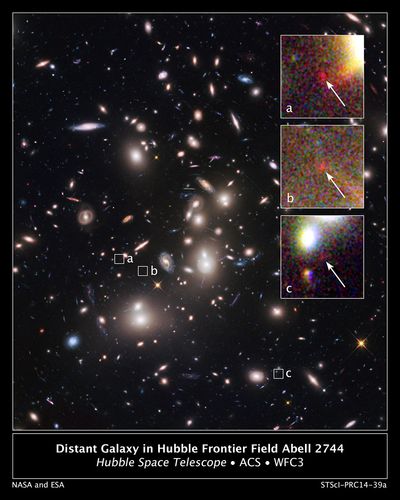 Hubble Uncovers One of the Smallest and Farthest Galaxies in the UniverseOctober 16, 2014
Hubble Frontier Fields Image of Abell 2744October 16, 2014
Abell 2744 Multiply-Lensed Background Galaxy at z=10 (Image A)October 16, 2014
Abell 2744 Multiply-Lensed Background Galaxy at z=10 (Image B)October 16, 2014
Abell 2744 Multiply-Lensed Background Galaxy at z=10 (Image C)October 16, 2014
 Abell 2744 Frontier FieldJanuary 7, 2014
Abell 2744October 24, 2013