
Galaxies
Stars’ Clockwork Motion Captured in Nearby Galaxy
February 18, 2014 · NASA · Large Magellanic Cloud · Dorado
Zoom to full resolution See where it is in the 3D sky Original on NASA ↗
This photo illustration shows Hubble measurements of the rotation of the Large Magellanic Cloud (LMC), the nearest visible galaxy to our Milky Way. The LMC appears in the Southern Hemisphere's night sky. In this photo illustration, the image contrast in a ground-based photo was enhanced to highlight the LMC's faint outer regions, which are not visible to the naked eye. To illustrate the LMC's large apparent size on the sky, an image of the full moon is shown at bottom right. A horizon has been added for perspective.
The arrows represent the highest-quality Hubble measurements of the motion of the LMC's stars to show how this galaxy rotates. Each arrow reveals the predicted motion over the next 7 million years. The motion of each star measured by Hubble over a few years' time is a million times smaller than the length of each arrow. The LMC completes a rotation every 250 million years.
About the data
The Hubble data are from proposals 9462 : C. Alcock (Harvard University), R. van der Marel (STScI), C. Nelson (University of California, Berkeley), T. Axelrod (University of Arizona), K. Cook (Eureka Scientific Inc.), A. Drake (Caltech), and M. Geha (Yale University); 10130 : C. Alcock (Harvard University), N. Kallivayalil (University of Virginia), R. van der Marel (STScI), M. Geha (Yale University), K. Cook (Eureka Scientific Inc.), A. Drake (Caltech), and T. Axelrod (University of Arizona); and 11730 : N. Kallivayalil (University of Virginia), R. van der Marel and J. Anderson (STScI), G. Besla (Columbia University), and C. Alcock (Harvard University).
More Hubble images of Large Magellanic Cloud
 Turquoise-tinted plumes in the Large Magellanic CloudOctober 13, 2014
 Hubble Surveys Dying Stars in Nearby GalaxyMarch 9, 2000
 Planetary Nebula in the LMC – Image 1March 9, 2000
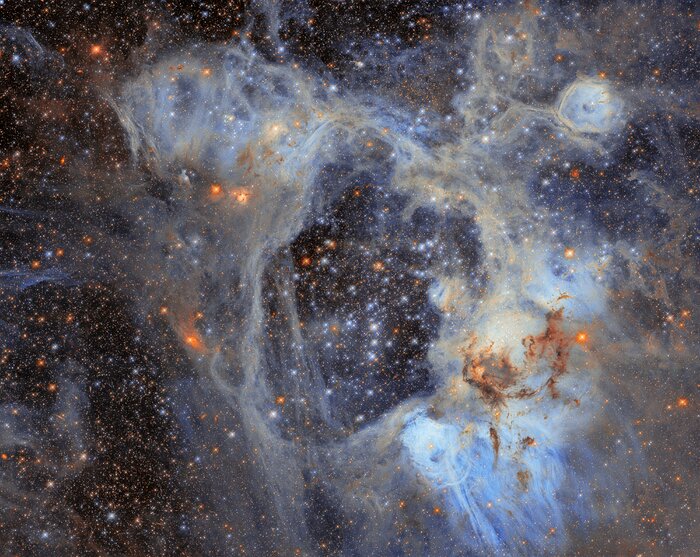 A superbubble sceneSeptember 3, 2026
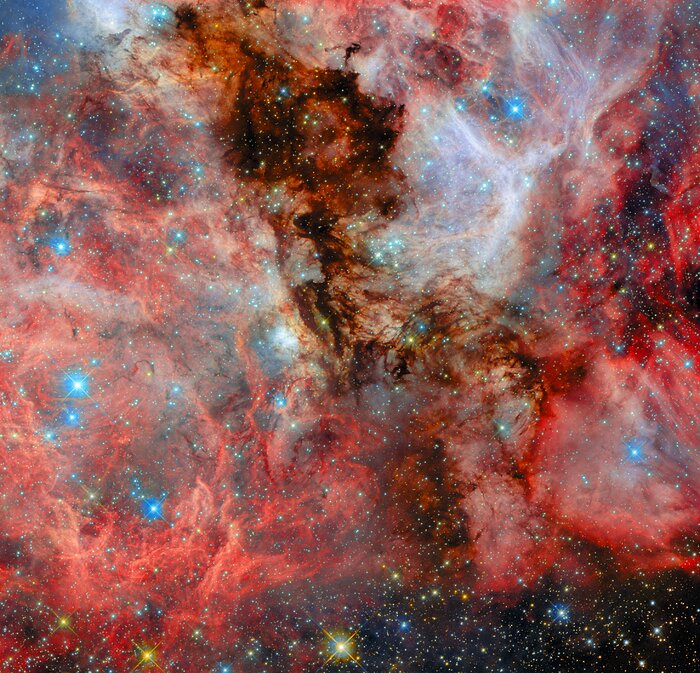 A neighbouring vista of stellar birthDecember 29, 2025
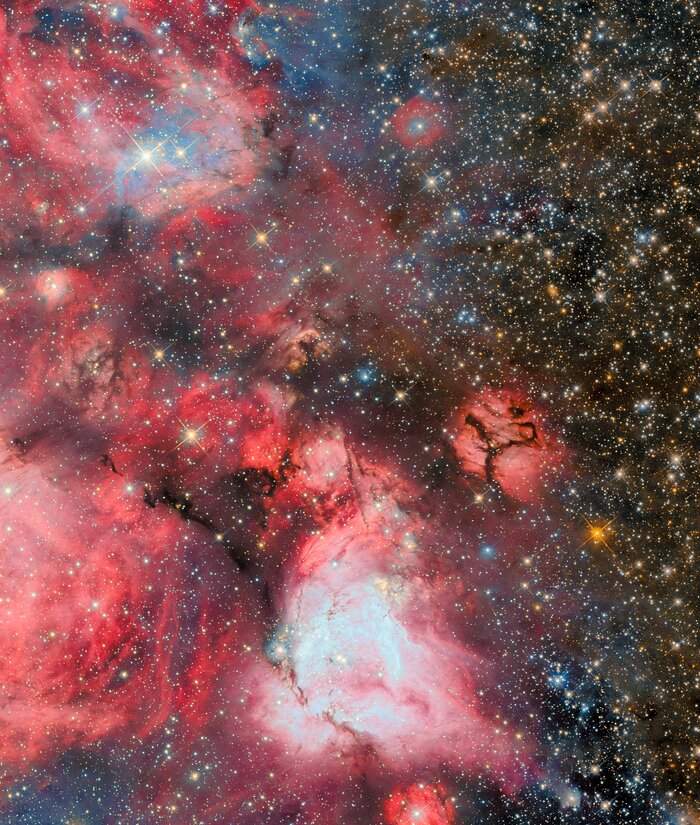 Baby stars blowing bubblesNovember 24, 2025
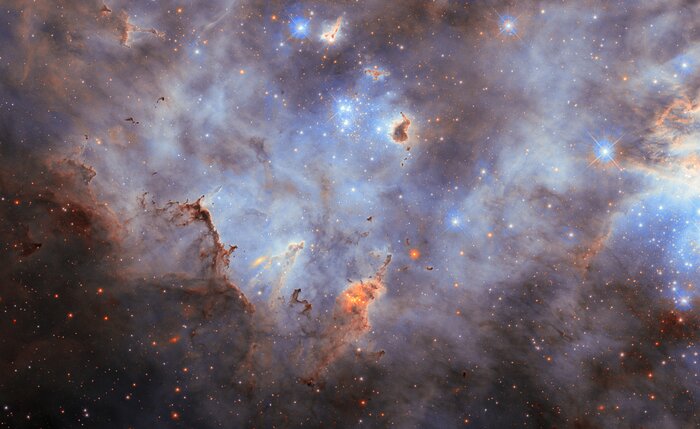 Cloudy clusterSeptember 8, 2025
 A sea monster and a TarantulaAugust 4, 2025