
Deep fields & lensing
Galaxy Cluster SDSS J1531+3414
July 10, 2014 · NASA · Corona Borealis
Zoom to full resolution See where it is in the 3D sky Original on NASA ↗
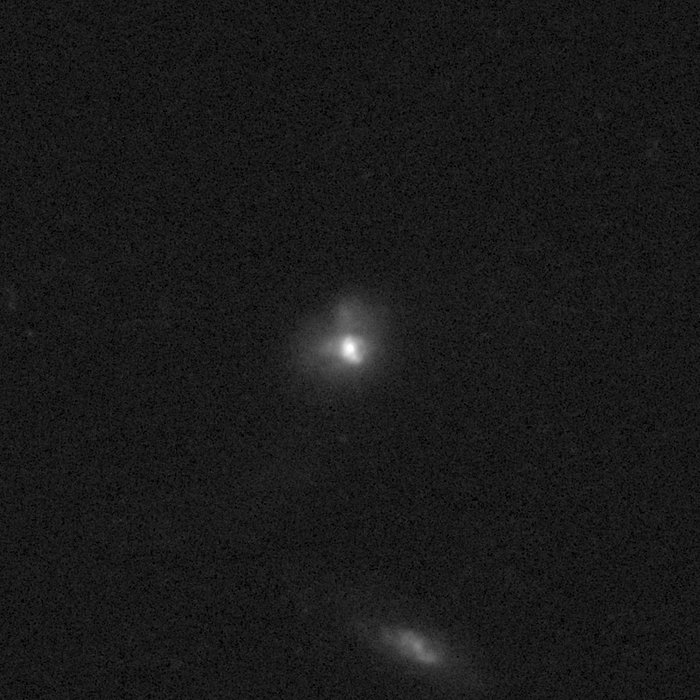
This is a Hubble Space Telescope photograph of a never-before-seen string of pearls twisted into a corkscrew shape that winds around the cores of two colliding galaxies. The "pearls" are superclusters of blazing, blue-white, newly born stars. The whole assembly must result from the gravitational tidal forces present in the galaxy collision. The serendipitous discovery was made while astronomers were studying the galaxy cluster SDSS J1531+3414.
The underlying physics behind the "beads on a string" shape is related to describing the behavior of self-gravitating clumps of gas. It's analogous to the process where rain falls in drops rather than in continuous filaments from clouds. It's called the Jeans instability, and it can play out on distance scales of enormous orders of magnitude.
About the colours
This composite image includes exposures acquired by the WFC3 instruments on the Hubble Space Telescope. Several filters were used to sample broad wavelength ranges. The color results from assigning different hues (colors) to each monochromatic (grayscale) image associated with an individual filter. In this case, the assigned colors are: Blue: F390W (C) Cyan: F606W (V) Yellow: F814W (I) Red: F160W (H)
About the data
The image was created from Hubble data from proposal 13003 : M. Gladders (University of Chicago), J. Rigby (NASA/GSFC), E. Wuyts (Max Planck Institute for Extraterrestrial Physics, Garching), K. Sharon (University of Michigan), M. Bayliss (Harvard University), H. Dahle (University of Oslo), and J. Hennawi (Max Planck Institute for Astronomy, Heidelberg).
The science team comprises: M. Gladders, M. Florian (University of Chicago), S. Baum, C. O'Dea, K. Cooke (Rochester Institute of Technology), M. Bayliss (Harvard-Smithsonian Center for Astrophysics), H. Dahle (University of Oslo, Norway), T. Davis (European Southern Observatory), J. Rigby (NASA/GSFC), K. Sharon (University of Michigan), E. Soto (Catholic University), and E. Wuyts (Max Planck Institute for Extraterrestrial Physics, Garching).
More Hubble images of SDSS J1531+3414
Galaxy Cluster SDSS J1531+3414 (Clean)July 10, 2014
Spiral Bridge of Young Stars in SDSS J1531+3414July 10, 2014
 Outflows from merging galaxy J1613+2834November 19, 2014
 Screenshot of Hubblecast 76July 10, 2014
 Droplets of star formation and two merging galaxies in SDSS J1531+3414July 10, 2014
 Wide field image of the region around two merging galaxies in SDSS J1531+3414 (ground based telescope)July 10, 2014
IRC 0218 Lensing FeatureJuly 31, 2014
IRC 0218 Lensing Feature Without Foreground ClusterJuly 31, 2014