
Galaxies
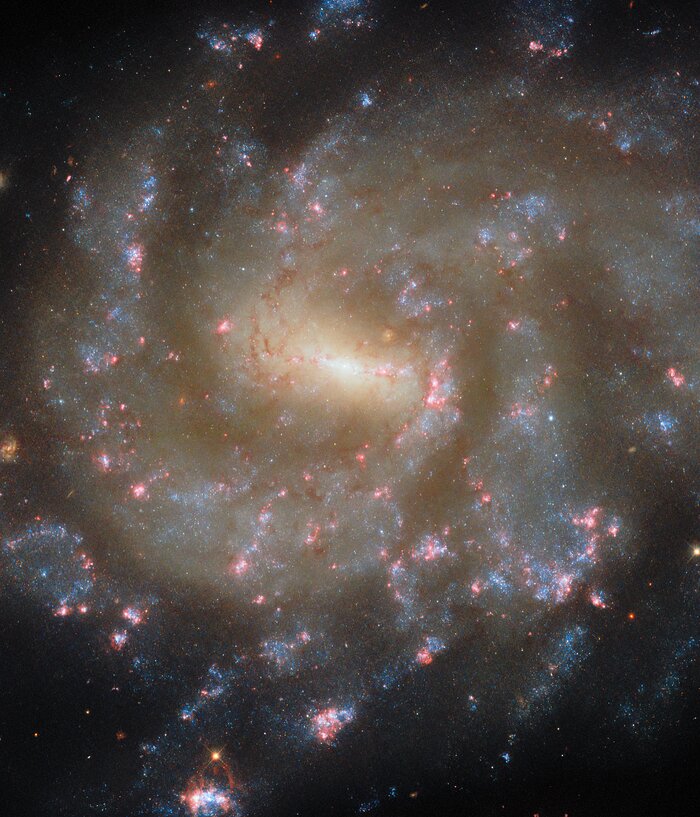
Supernova 2012Z in Spiral Galaxy NGC 1309
August 6, 2014 · NASA · Supernova 2012Z, NGC 1309 · Eridanus
Zoom to full resolution See where it is in the 3D sky Original on NASA ↗
The inset panel is a pair of Hubble Space Telescope images of the spiral galaxy NGC 1309 that were taken before and after the appearance of Supernova 2012Z, in the outskirts of the galaxy. The white X-shaped feature at the top of the image of the galaxy marks the location of the supernova.
The inset panel from 2013 shows the supernova; archival Hubble data from 2005 and 2006 show the progenitor system for the supernova, thought to be a binary system containing a helium star transferring material to a white dwarf that exploded.
The stellar blast is a member of a unique class of supernova called Type Iax. These supernovae are less energetic, and hence fainter, on average, than their well-known cousins, Type Ia supernovae, which also originate from exploding white dwarfs in binary systems.
About the colours
This image is a composite of separate exposures acquired by the ACS/WFC and WFC3/UVIS instruments. Several filters were used to sample various wavelengths. The color results from assigning different hues (colors) to each monochromatic (grayscale) image as follows: Image of NGC 1309 and 2005-2006 inset image: Blue: F435W (B) Green: F555W (V) Red: F814W (I) 2013 inset image: Blue: F555W (V) Green: F625W (R) Red: F814W (I)
About the data
Hubble data for this release were obtained from the following proposals: 10497 , 10802 , 11570 , and 12880 : A. Riess (JHU/STScI) et al. 10711 : K. Noll (NASA/GSFC) et al. 12913 : S. Jha (Rutgers University) et al.
The science team comprises: C. McCully and S. Jha (Rutgers University), R. Foley (University of Illinois, Urbana-Champaign), L. Bildsten (University of California, Santa Barbara/ Kavli Institute for Theoretical Physics) W.-f. Fong and R. Kirshner (Harvard-Smithsonian/CfA), G. Marion (University of Texas, Austin and Harvard-Smithsonian/CfA), A. Riess (JHU/STScI) and M. Stritzinger (Aarhus University, Denmark).
More Hubble images of Supernova 2012Z, NGC 1309
2005-2006 Hubble Images of Progenitor System for Supernova 2012ZAugust 6, 2014
2013 Hubble Image of Supernova 2012ZAugust 6, 2014
 Hubble seeks lensed supernova, marks 200,000 orbitsSeptember 30, 2026
 SN 2025pht in NGC 1637February 23, 2026
 An anomaly from Hubble’s archive — Merging galaxies 2January 27, 2026
 An anomaly from Hubble’s archive — Gravitational lens 1January 27, 2026
 A supernova-rich spiralJuly 28, 2025
 Starry spectacleJune 2, 2025