
Galaxies
Supernova 1993J in Spiral Galaxy M81
September 9, 2014 · NASA · SN 1993J, Supernova 1993J · Ursa Major
Zoom to full resolution See where it is in the 3D sky Original on NASA ↗
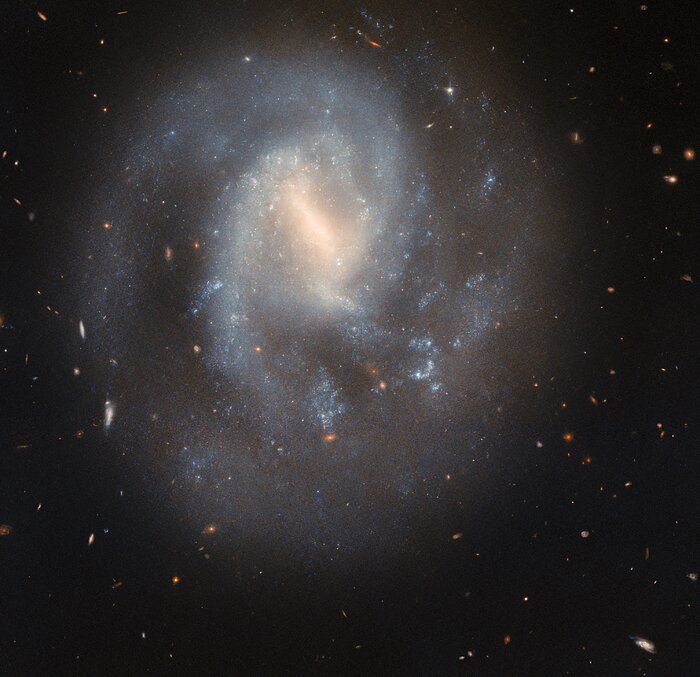
This Hubble Space Telescope photo composite shows the location of supernova 1993J inside the majestic spiral galaxy M81. Though astronomers saw the star explode as a supernova 21 years ago, the glow of that explosion is still present, as seen in the inset image. The supernova has faded to the point where astronomers are confident that they have picked up the ultraviolet glow of a very hot companion star. This is the first time astronomers have been able to put constraints on the properties of the companion star in this unusual class of supernova called Type IIb. Hubble observations in ultraviolet light confirm the theory that the explosion originated in a double-star system where one star fueled the mass-loss from the aging primary star.
About the colours
The galaxy M81 image is a composite of many separate exposures made by the ACS instrument on the Hubble Space Telescope. Three filters were used to sample light from broad wavelengths. The color results from assigning different hues (colors) to each monochromatic image. In this case, the assigned colors are: Blue: F435W (B) Green: F606W (V) Red: F814W (I) The inset image of SN 1993J is a composite of separate exposures acquired by the ACS/WFC instrument. Several filters were used to sample various wavelengths. The color results from assigning different hues (colors) to each monochromatic (grayscale) image as follows: Blue: F438W (B) Green: F555W (V) Red: F625W (r)
About the data
Note: The wide-field image of M81 was released on May 28, 2007. ACS/WFC data from proposal 10584 (PI: A. Zezas (Harvard-Smithsonian Center for Astrophysics)) was combined into a BVI color-composite image.
Hubble data for this release of SN 1993J were obtained from proposal 12531 : A. Filippenko (University of California, Berkeley), P. Chandra (Pune University, India), R. Chevalier (University of Virginia), V. Dwarkadas (University of Chicago), C. Fransson (Stockholm University), W. Li (University of California, Berkeley) T. Matheson (NOAO), J. Silverman (University of Texas, Austin), N. Smith (Steward Observatory), and S. Van Dyk (Caltech).
The science team comprises: O. Fox (University of California, Berkeley), A. Bostroem (STScI), S. Van Dyk (Caltech), A. Filippenko (University of California, Berkeley), C. Fransson (Stockholm University), T. Matheson (NOAO), S. Cenko (University of California, Berkeley, and NASA/GSFC), P. Chandra (Pune University, India), V. Dwarkadas (University of Chicago), W. Li and A. Parker (University of California, Berkeley), and N. Smith (Steward Observatory).
More Hubble images of SN 1993J, Supernova 1993J
HST ACS Image of M81September 9, 2014
HST WFC3 Image of Supernova 1993JSeptember 9, 2014
 M82 Cigar Galaxy (Webb + Hubble)June 23, 2026
 Cloud 9, Starless Gas CloudJanuary 5, 2026
 Massive stars make their markDecember 8, 2025
 Revisiting an unusual spiralNovember 3, 2025
 The smouldering heart of a celestial cigarSeptember 15, 2025
 Stirring the interstellar soupJune 9, 2025