
Black holes
Elliptical Galaxy M60
September 17, 2014 · NASA · Virgo
Zoom to full resolution See where it is in the 3D sky Original on NASA ↗
This is a Hubble Space Telescope image of the massive elliptical galaxy M60. The galaxy lies about 50 million light-years away inside the immense Virgo Cluster of 2,500 galaxies. A portion of the faint bluish spiral galaxy NGC 4647 can be seen in the upper right corner of this image.
About the colours
The images are composites of separate exposures made by the ACS/WFC and WFPC2 instruments on the Hubble Space Telescope. Four filters were used to sample broad and narrow wavelength ranges for the UVIS image. The colors result from assigning different hues (colors) to each monochromatic image. In this case, the assigned colors are: Blue: ACS/WFC F475W (B) + WFPC2 F555W (V) Green: F475W (B) + F555W (V) + F850LP (z) + F814W (I) Red: ACS/WFC F850LP (z) + WFPC2 F814W (I)
About the data
Data for this science result comes from the HST proposal: 12369 G. Fabbiano (Harvard-Smithsonian Center for Astrophysics), T. Fragos and V. Kalogera (Northwestern University), D.-W. Kim and A. Zezas (Harvard-Smithsonian Center for Astrophysics), J. Gallagher III (University of Wisconsin, Madison) , A. King (University of Leicester), J. Strader (Harvard University), and J. Brodie (University of California, Santa Cruz).
The release image of M60 also includes data from proposals 9043 , PI: J. Tonry (University of Hawaii) and 9410 , PI: P. Cote (Dominion Astrophysical Observatory).
The science team comprises: A. Seth (University of Utah), R. van den Bosch (Max Planck Institute for Astronomy, Heidelberg), S. Mieske (ESO Chile), H. Baumgardt (University of Queensland), M. den Brok (University of Utah), J. Strader (Michigan State University), N. Neumayer (ESO Garching), I. Chilingarian (Harvard-Smithsonian Center for Astrophysics/Moscow State University), M. Hilker (ESO Garching), R. McDermid and L. Spitler (Australian Astronomical Observatory/Macquarie University, Sydney), J. Brodie (University of California, Santa Cruz), M. Frank (Center of Astronomy/Heidelberg University), and J. Walsh (University of Texas, Austin).
More from Virgo and nearby
 A galaxy spinning out of syncSeptember 18, 2026
 One-sided spiralJuly 24, 2026
 Galactic gas makes a getawayDecember 15, 2025
 Finding star clusters in the Lost GalaxyNovember 17, 2025
NGC 5335April 23, 2025
 Sombrero GalaxyApril 16, 2025
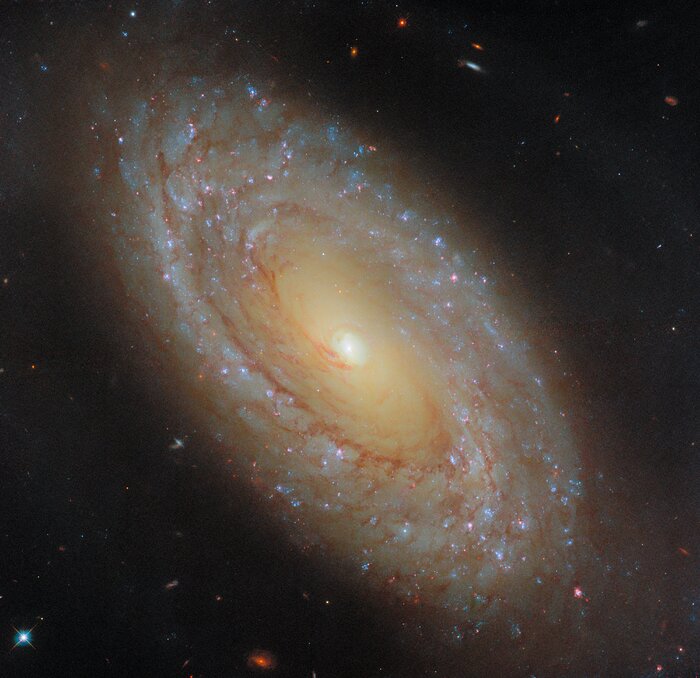 A galaxy that gives great feedbackMarch 31, 2025
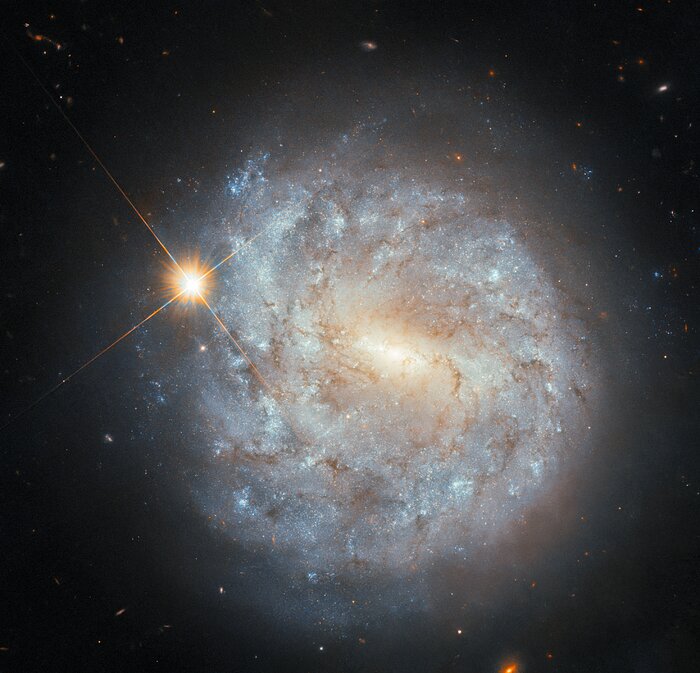 A spiral and a starMarch 10, 2025