
Black holes
Active Galaxy 3C 264 (NGC 3862)
May 27, 2015 · NASA · 3C 264, NGC 3862 · Leo
Zoom to full resolution See where it is in the 3D sky Original on NASA ↗
[Left] In this NASA Hubble Space Telescope image of the central region of the galaxy NGC 3862, an extragalactic jet of material moving at nearly the speed of light can be seen at the three o'clock position. The jet of ejected plasma is powered by energy from a supermassive black hole at the center of the elliptical galaxy, which is located 260 million light-years away in the constellation of Leo.
[Right] A sequence of Hubble images of knots (outlined in red, green, and blue) shows them moving along the jet over a 20-year span of observing. Astronomers were surprised to discover that the central knot (green) caught up with and merged with the knot in front of it (blue). The new analysis suggests that shocks produced by collisions within the jet further accelerate particles that are confined to a narrowly focused beam of radiation. The "X" marks the location of the black hole.
About the data
Observations of 3C 264 were taken from Hubble data from the following proposals: 13327 : E. Meyer, W.B. Sparks, J. Biretta, R. van der Marel, J. Anderson, and S.T. Sohn (STScI), M. Chiaberge (STScI/ESA), C. Norman (JHU), E. Perlman (Florida Institute of Technology), M. Nakamura (Academia Sinica, Taiwan), and from the following archival proposals: 9069 : J. Biretta and W.B. Sparks (STScI), 5927 , PI: H. Ford (JHU) et al., and 5476 , PI: W.B. Sparks (STScI) et al.
The science team comprises: E. Meyer (STScI), M. Georganopoulos (UMBC/NASA GSFC), W.B. Sparks (STScI), E. Perlman (Florida Institute of Technology), R. van der Marel, J. Anderson (STScI), S.T. Sohn (JHU), J. Biretta (STScI), C. Norman (STScI/JHU), and M. Chiaberge (STScI/ESA).
More Hubble images of 3C 264, NGC 3862
HST Wide-Field Image of 3C 264 (2014)May 27, 2015
HST Close-Up Image of 3C 264 Jet (1994)May 27, 2015
HST Wide-Field Image of 3C 264 (1996)May 27, 2015
HST Close-Up Image of 3C 264 Jet (2002)May 27, 2015
HST Close-Up Image of 3C 264 Jet (2014)May 27, 2015
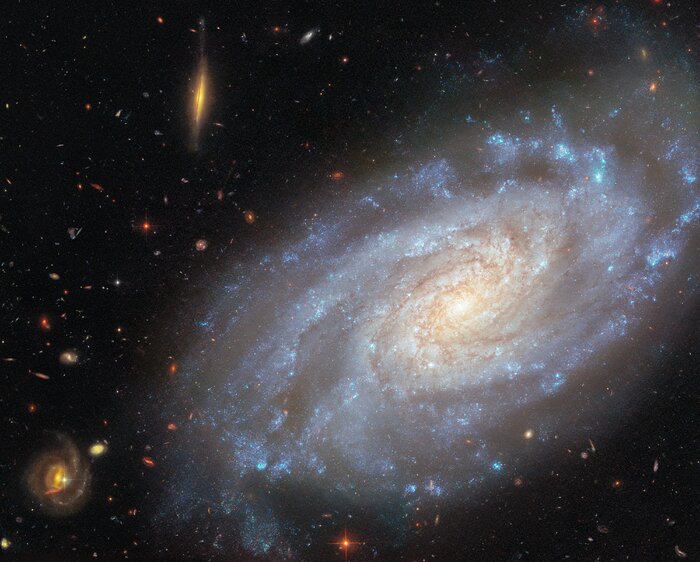 Focusing on NGC 3370October 20, 2025
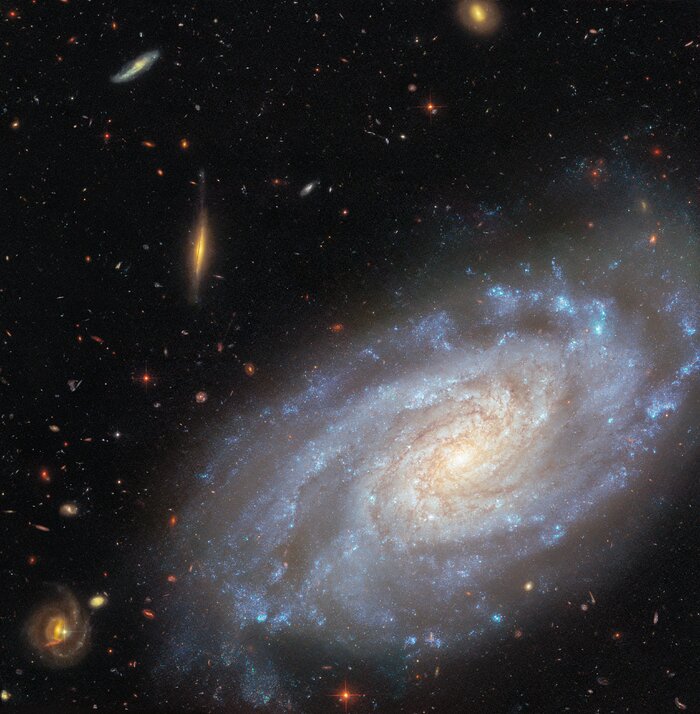 NGC 3370 (wide view)October 20, 2025
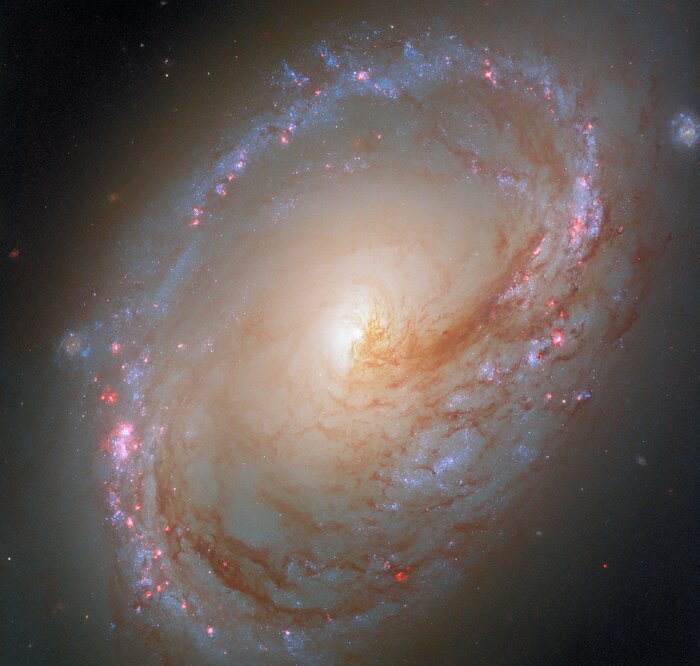 Taking a third lookAugust 25, 2025