
Solar System
Comet 252P/LINEAR (April 4, 2016)
May 12, 2016 · NASA
This sequence of images taken by NASA's Hubble Space Telescope shows Comet 252P/LINEAR as it passed by Earth. The visit was one of the closest encounters between a comet and our planet.
The images were taken on April 4, 2016, roughly two weeks after the icy visitor made its closest approach to Earth on March 21. The comet traveled within 3.3 million miles of Earth, or about 14 times the distance between our planet and the moon. These observations also represent the closest celestial object Hubble has observed, other than the moon.
The images reveal a narrow, well-defined jet of dust ejected by the comet's icy, fragile nucleus. The nucleus is too small for Hubble to resolve. Astronomers estimate that it is less than one mile across. A comet produces jets of material as it travels close to the sun in its orbit. Sunlight warms ices in a comet's nucleus, resulting in large amounts of dust and gas being ejected, sometimes in the form of jets. The jet in the Hubble images is illuminated by sunlight.
The jet also appears to change direction in the images, which is evidence that the comet's nucleus is spinning. The spinning nucleus makes the jet appear to rotate like the water jet from a rotating lawn sprinkler. The images underscore the dynamics and volatility of a comet's fragile nucleus.
Comet 252P/LINEAR is traveling away from Earth and the sun; its orbit will bring it back to the inner solar system in 2021, but not anywhere close to Earth.
These visible-light images were taken with Hubble's Wide Field Camera 3.
About the colours
This image was originally black and white and recorded only overall brightness. These brightness values were translated into a range of bluish hues. Such color "maps" can be useful in helping to distinguish subtly varying brightness in an image.
About the data
The images were created from Hubble data from proposal 14103 : J.-Y. Li and N. Samarasinha (Planetary Science Institute), M. Kelley (University of Maryland), M. Mutchler (STScI), and D. Farnocchia (Jet Propulsion Laboratory).
More Hubble images of Comet 252P/LINEAR
Comet 252P/LINEAR (April 4, 2016 – 16:10 UT)May 12, 2016
Comet 252P/LINEAR (April 4, 2016 – 18:25 UT)May 12, 2016
Comet 252P/LINEAR (April 4, 2016 – 20:56 UT)May 12, 2016
Full Color Neptune Global Map from Hubble’s OPAL Program (Dark Spot and Companion Clouds Closeup)June 23, 2016
Blue Light Neptune Global Map from Hubble’s OPAL Program (Dark Spot Closeup)June 23, 2016
Mars Near 2016 OppositionMay 19, 2016
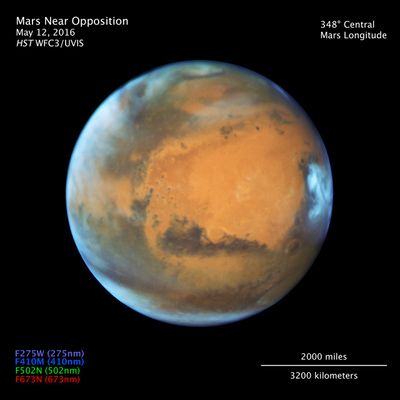 Scale Image for MarsMay 19, 2016
Time-Lapse Sequence Reveals a Jet Rotating with Comet 252P/LINEARMay 12, 2016 · video