
Nebulae
NGC 248 in the Small Magellanic Cloud
December 20, 2016 · NASA · NGC 248, DEM S 16, SMC N13 · Tucana
Zoom to full resolution See where it is in the 3D sky Original on NASA ↗
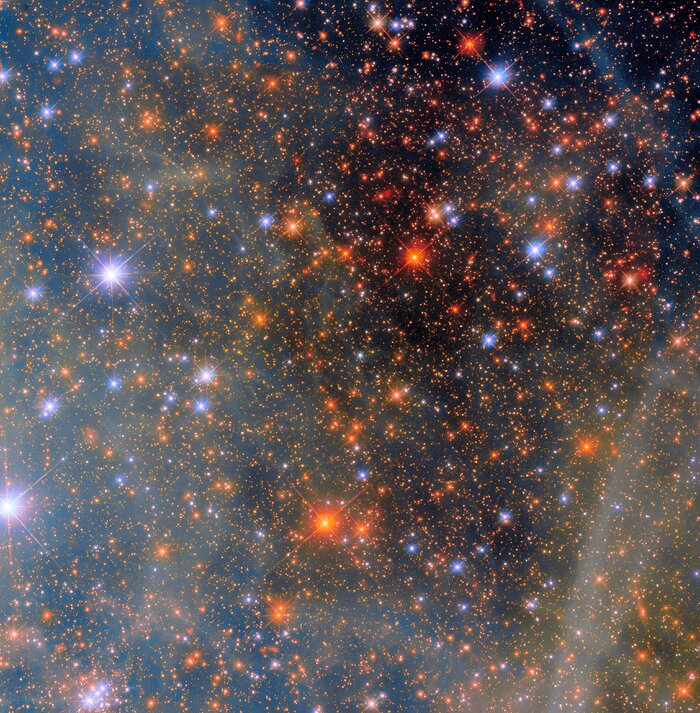
NASA's Hubble Space Telescope captured two festive-looking nebulas, situated so as to appear as one. They reside in the Small Magellanic Cloud, a dwarf galaxy that is a satellite of our Milky Way galaxy. Intense radiation from the brilliant central stars is heating hydrogen in each of the nebulas, causing them to glow red.
The nebulas, together, are called NGC 248. They were discovered in 1834 by the astronomer Sir John Herschel. NGC 248 is about 60 light-years long and 20 light-years wide. It is among a number of glowing hydrogen nebulas in the dwarf satellite galaxy, which is located approximately 200,000 light-years away in the southern constellation Tucana.
The image is part of a study called Small Magellanic Cloud Investigation of Dust and Gas Evolution (SMIDGE). Astronomers are using Hubble to probe the Milky Way satellite to understand how dust is different in galaxies that have a far lower supply of heavy elements needed to create dust. The Small Magellanic Cloud has between a fifth and a tenth of the amount of heavy elements that the Milky Way does. Because it is so close, astronomers can study its dust in great detail, and learn about what dust was like earlier in the history of the universe. "It is important for understanding the history of our own galaxy, too," explained the study's principal investigator, Dr. Karin Sandstrom of the University of California, San Diego. Most of the star formation happened earlier in the universe, at a time where there was a much lower percentage of heavy elements than there is now. "Dust is a really critical part of how a galaxy works, how it forms stars," said Sandstrom.
The data used in this image were taken with Hubble's Advanced Camera for Surveys in September 2015.
About the colours
This image is combined from separate exposures acquired by HST's ACS/WFC instrument. Four filters were used to sample different wavelength bands. The color results from assigning different hues (colors) to each monochromatic (grayscale) image associated with an individual filter. In this case, the assigned colors are: Blue: F475W (B) Green: F550M (narrow V) Orange: F658N (H-alpha) Red: F814W (i)
About the data
These datasets are from the HST proposal 13659 , P.I.: K. Sandstrom (University of California, San Diego).
More from Tucana and nearby
 Hubble Spots Stellar Sculptors in NGC 346April 4, 2025
 Colourful clouds of a nearby neighbourMarch 17, 2025
 A dynamic duo … or trio?October 23, 2023
 Head in the CloudsDecember 5, 2022
 NGC 346September 8, 2022
 Four Filter FusionDecember 6, 2021
 A Scattering of StarsJune 28, 2021
 Hubble Captures the Supernova Remnant 1E 0102.2-7219January 15, 2021