
Deep fields & lensing
Hubble Pushed Beyond Limits to Spot Clumps of New Stars in Distant Galaxy
July 6, 2017 · NASA · Galaxy cluster SDSS J1110+6459, lensed galaxy SGAS J111020.0+645950.8 · Ursa Major
Zoom to full resolution See where it is in the 3D sky Original on NASA ↗
In this Hubble photograph of a distant galaxy cluster, a spotty blue arc stands out dramatically against a background of red galaxies. That arc is actually three separate images of the same background galaxy. The background galaxy has been gravitationally lensed, its light magnified and distorted by the intervening galaxy cluster.
By using the magnifying power of this natural cosmic lens, astronomers have been able to study the background galaxy in intimate detail. Through sophisticated computer processing, they determined how the galaxy’s image has been warped by gravity. The image at right shows how the galaxy would look to Hubble without distortions.
It reveals a disk galaxy containing clumps of star formation that each span about 200 to 300 light-years. This contradicts theories suggesting that star-forming regions in the distant, early universe were much larger, 3,000 light-years or more in size.
About the colours
This image is a composite of separate exposures made by the WFC3 instrument on the Hubble Space Telescope using two different cameras and filters isolating the light of specific elements or of specific broad wavelength ranges. The color arises by assigning different hues (colors), to each monochromatic image. In this case, the colors are: blue WFC3/UVIS F390W, green WFC3/UVIS F606W, orange/red: WFC3/IR F105W, red WFC3/IR F160W.
About the data
The Hubble image was created from HST data from proposal 13003 M. Gladders (U. Chicago)
More from Ursa Major and nearby
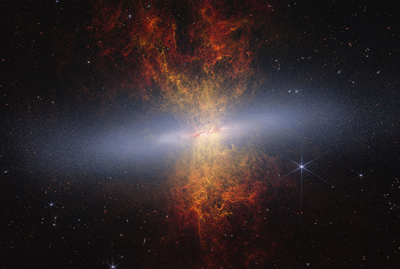 M82 Cigar Galaxy (Webb + Hubble)June 23, 2026
 Cloud 9, Starless Gas CloudJanuary 5, 2026
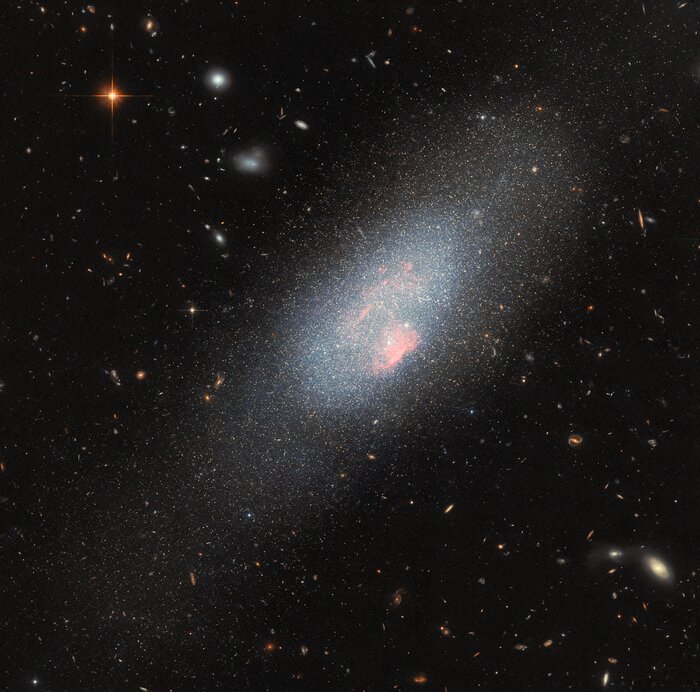 Massive stars make their markDecember 8, 2025
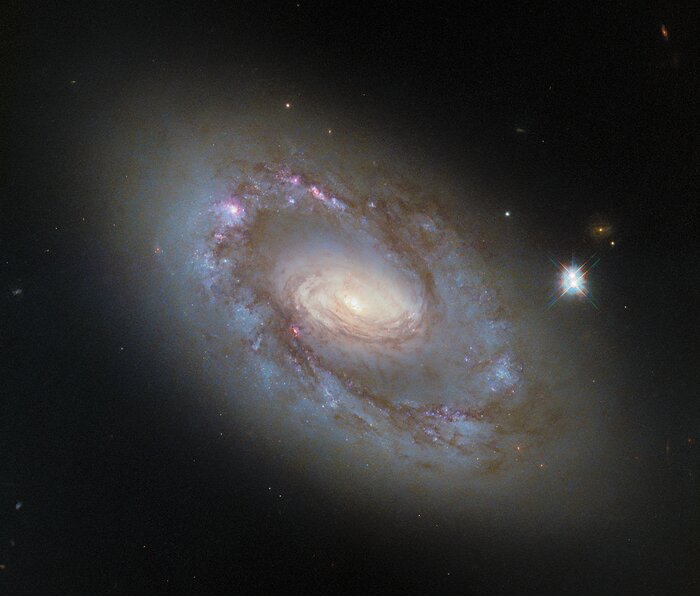 Revisiting an unusual spiralNovember 3, 2025
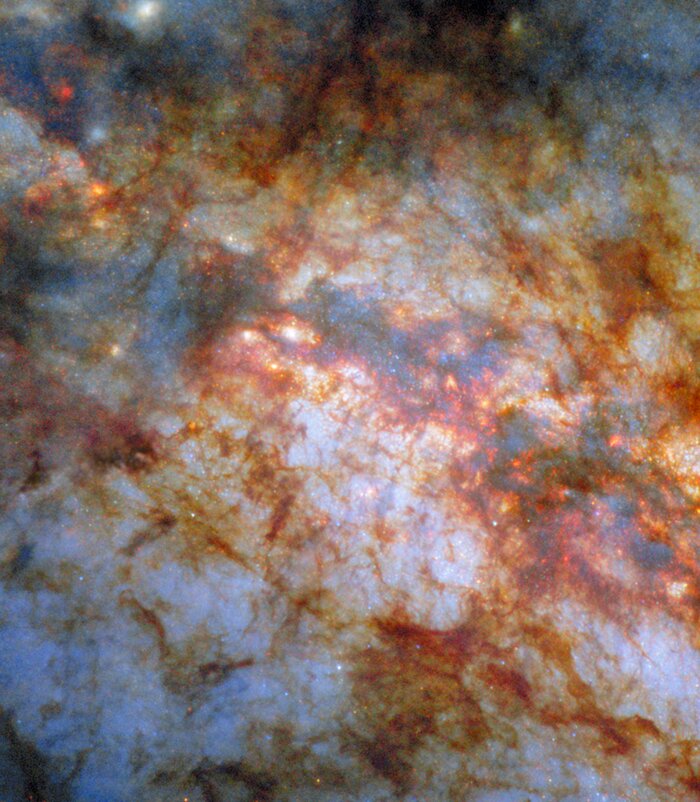 The smouldering heart of a celestial cigarSeptember 15, 2025
 Stirring the interstellar soupJune 9, 2025
 A spiral hiding an impostorFebruary 17, 2025
 “Late-type” galaxy?November 20, 2023