
Star clusters
Large Magellanic Cloud (DSS View) with Star Cluster Overlay (Hubble)
April 25, 2019 · NASA · Dorado
Zoom to full resolution See where it is in the 3D sky Original on NASA ↗
Astronomers Use Hubble to Tighten the Cosmic Distance Ladder
This is a ground-based telescope's view of the Large Magellanic Cloud, a satellite galaxy of our Milky Way. The inset image, taken by the Hubble Space Telescope, reveals one of many star clusters scattered throughout the dwarf galaxy.
The cluster members include a special class of pulsating star called a Cepheid variable, which brightens and dims at a predictable rate that corresponds to its intrinsic brightness. Once astronomers determine that value, they can measure the light from these stars to calculate an accurate distance to the galaxy. When the new Hubble observations are correlated with an independent distance measurement technique to the Large Magellanic Cloud (using straightforward trigonometry), the researchers were able to strengthen the foundation of the so-called "cosmic distance ladder." This "fine-tuning" has significantly improved the accuracy of the rate at which the universe is expanding, called the Hubble constant.
About the colours
These images are composites of separate exposures acquired by the WFC3 instrument on the Hubble Space Telescope. Several filters were used to sample broad wavelength ranges. The color results from assigning different hues (colors) to each monochromatic (grayscale) image associated with an individual filter. In this case, the assigned colors are: Blue: F555W (V) Green: F555W (V) and F814W (I) Red: F814W (I)
About the data
Data of cepheid variable stars in the LMC were obtained from the HST proposal 15146 (A. Riess)
More from Dorado and nearby
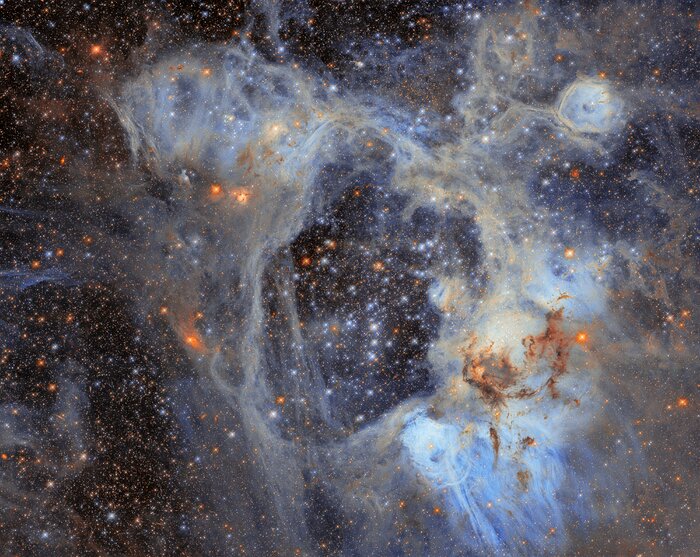 A superbubble sceneSeptember 3, 2026
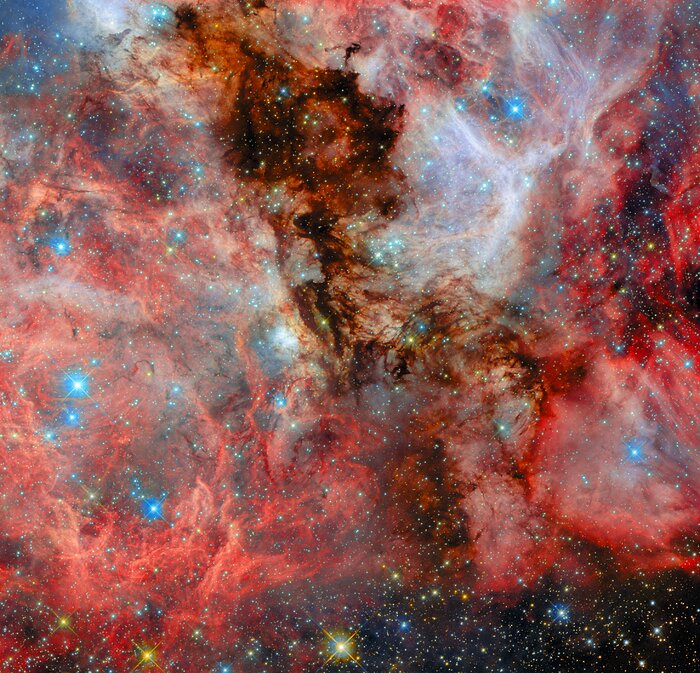 A neighbouring vista of stellar birthDecember 29, 2025
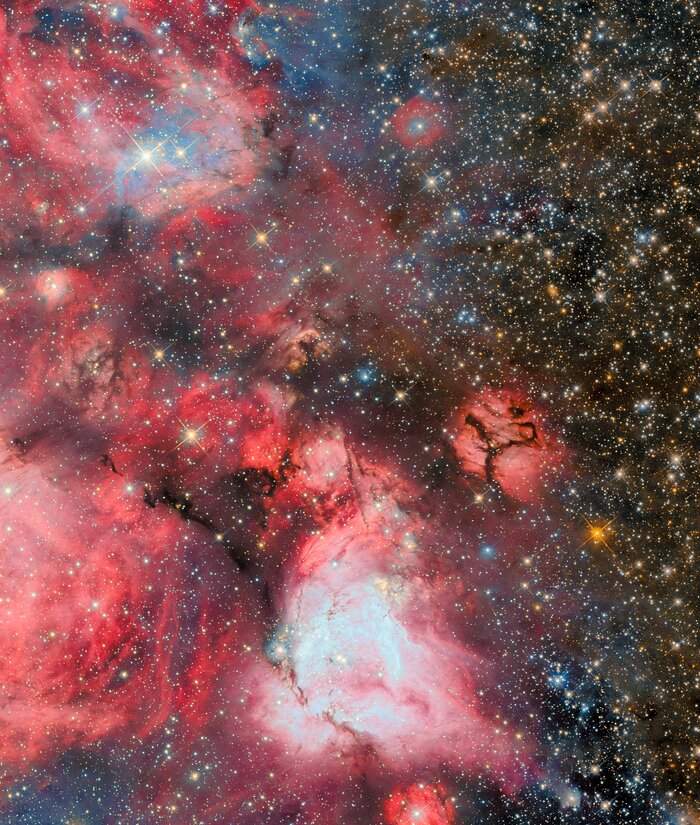 Baby stars blowing bubblesNovember 24, 2025
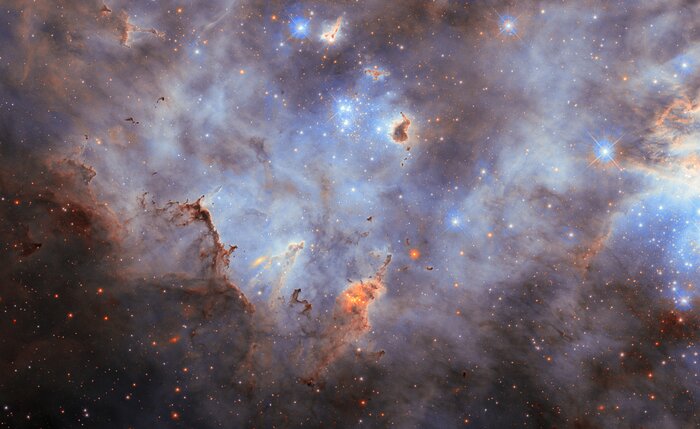 Cloudy clusterSeptember 8, 2025
 A sea monster and a TarantulaAugust 4, 2025
 Digging up a galactic time capsuleJuly 14, 2025
 Capturing candyfloss cloudsMay 12, 2025
 Cosmic cloudscapeFebruary 10, 2025